



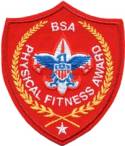
Physical Fitness Award
Discontinued
The award's objectives, developed by the Council Services Division of the National Council and the national BSA Health and Safety Committee, are as follows:
- Encourage youth fitness in the BSA by providing positive role models and by enhancing youth awareness and understanding of fitness parameters, health risks, and personal circumstances.
- Encourage physical fitness among Scouters by enhancing their awareness and understanding of fitness parameters, health risks, and personal circumstances.
- Reduce the rate of stress- and fitness-related incidents throughout Scouting.
People who earn the recognition can receive a special certificate and can purchase and wear the unique BSA Physical Fitness Award patch. In addition, upon completion of the Fitness Award requirements, Scouts and Scouters may wear a special recognition pin and patch that can be purchased through their local council.
This award is a national program of emphasis designed to heighten fitness awareness and to help change the lifestyles of American youth and adults regarding exercise and a healthy diet to improve the quality of their lives.
This award has been developed to:
- Encourage the development of attitudes, knowledge, and skills that promote fitness and safe conduct.
- Lay a skill, knowledge, and attitude foundation of the seven major components of fitness.
- Improve health, fitness, and quality of life through daily physical activity.
The BSA Physical Fitness Award's core requirements are the following seven major components. They are used to measure an individual's improvement over time, not to establish an arbitrary minimum level of activity.
Posture: Posture is evaluated with a posture-rating chart. The Scout or Scouter is compared to a photo of his or her starting posture, noting 13 different body segments. Each body segment is scored as a five, three, or one, making a possible range of scores from 13 to 65. Higher scores over time reflect improving posture.
Accuracy: The target throw is used to measure accuracy. The Scout or Scouter makes 20 throws with a softball at a circular target and is scored on the number of times the target is hit.
Strength: The sit-up is used to measure strength. The Scout or Scouter lies on his or her back with knees bent and feet on the floor. The arms are crossed on the chest with the hands on the opposite shoulders. The feet are held by a partner to keep them on the floor. Curl to the sitting position until the elbows touch the thighs. Arms must remain on the chest and chin tucked on the chest. Return to the starting position, shoulder blades touching the floor. The score is the number of sit-ups made in a given time.
Agility: The side step is used to measure agility. Starting from a center line, the Scout or Scouter sidesteps alternately left and right between two lines 8 feet apart. He or she is scored on the number of lines crossed in 10 seconds.
Speed: The dash is used to measure speed. The score is the amount of time to the nearest half-second running a set distance that can be increased each year.
Balance: The squat stand is used to measure balance. The Scout or Scouter squats with hands on the floor and elbows against the inner knee. He or she leans forward until the feet are raised off the floor. The score is the number of seconds held in that position.
Endurance: The squat thrust is used to measure endurance. The Scout or Scouter starts from the standing position. He or she performs the usual four-position exercise. The score is the number of completed squat thrusts made in a given time.
Some of these tests measure more than the components they represent. For example, the sit-ups, a measure of strength, also reflect some endurance because of their repetition. The squat stand requires balance, its major component, but also requires strength and endurance to support the weight of the body on the arms.
Requirements:
- Complete a cardiovascular fitness evaluation/consultation with your personal health care provider. (This can be done as part of the examination required by any council-approved class 3 medical evaluation.)
- Using the BSA references listed after the seven major components, give a presentation to a BSA or other community youth group (at least eight youth participants) on cardiovascular fitness, diet, the health benefits of regular aerobic exercise, exercise recommendations for the Scout-age group, and healthy lifestyles.
- Review the BSA guidelines for the Athletics and other physical activity or personal fitness-oriented merit badge and explain steps you have taken to follow each of the guidelines for the fitness goals. Explain precautions to be taken for a physical fitness activity in each of the following: woods, fields, facilities, and waterfront.
- Explain to your mentor the symptoms of dehydration and hypothermia. Explain the special considerations for preventing dehydration and hypothermia.
- Properly outfit for physical activities with proper equipment, clothing, and footwear. Know your own capabilities and limitations. Illustrate how you would prepare for the physical fitness goals included in the award program.
- With supervision from your mentor or other qualified persons, set up a fitness goal-oriented plan using the seven major components of fitness.
- Demonstrate your ability to improve your strength, posture, endurance, agility, speed, accuracy, and balance with your own goal-oriented fitness plan.
Click one to vote:


Comments:
Apr 20, 2013 - Nikki1234
Apr 13, 2014 - Amy
Apr 13, 2014 - Scouter Paul
Apr 21, 2014 - Amy
Apr 22, 2014 - Sean Geffert
Scouting 2026 - Ask a Question - Add Content
Just for Fun: Socializing merit badge


Find more Scouting Resources at www.BoyScoutTrail.com
Follow Me, Scouts
Recent Comments