



4 Square | |
| Intended for: | Scouts BSA |
| Required: | 4 patrols volleyball or rubberball chalk |
| Preparation: | Mark a 16x16 square and divide it into four 8x8 squares. |
| Instructions: | Each patrol lines up at a corner of the play area. First player for each patrol enters their square. Scout for patrol #1 serves the ball into square 2, 3, or 4 and then runs to the end of the patrol line while the next scout takes the place in their square. When the ball enters your square, you must hit it out to either square from which the ball DID NOT come and then have your next patrol member take your place. For example, if #1 hits the ball into #3, then #3 can hit it to #2 or #4 but NOT to #3. When a patrol fails to return a hit, that patrol is penalized 1 point. The patrol with the least points after a set time wins. |
Find more Scouting Resources at BoyScoutTrail.com
4 Way Tug-o-War | |
| Intended for: | Scouts BSA, Bear Scouts, Webelos Scouts |
| Required: | 4 teams 4 25foot lengths of rope kerchief or rag |
| Preparation: | Tie the 4 lengths of rope together into a circle. Lay the rope out in a square on the ground with the knots at the corners. Put a rag in the very center of the square. |
| Instructions: | Each team lines up on a side of the rope square. On the 'GO' signal, everyone picks up the rope and starts pulling. After a set time limit, the stop signal is given and the team that has made the most progress away from the center marker wins. |
Find more Scouting Resources at BoyScoutTrail.com
500 | |
| Intended for: | All Scouts |
| Required: | frisbee, softball, rubber ball, football, or any other throwing item. |
| Instructions: | The object is to catch the frisbee enough times to become the thrower. One scout starts as the thrower and the other scouts gather around the throwing distance from the thrower. The thrower yells out, "100" or "200" or any amount the thrower wants the throw to be worth. Then, throw the frisbee towards the group of scouts. Whoever catches the frisbee gains the stated points. The first person to reach 500 becomes the thrower. Variations:
|
 A Favorite Game
 Find more Scouting Resources at BoyScoutTrail.com
Ace-King-Queen | |
| Intended for: | All Scouts |
| Required: | 3 or more scouts 1 bouncing rubber ball |
| Instructions: | Ace-King-Queen is a "work your way up" game for any number of scouts with a hard floor and wall that can be hit by a small rubber ball. It's great as a gathering game or any time there's some dead time. Scouts line up from left to right, with the "Ace" on the far left, "King" next, then "Queen", "Jack", "10", ... and so on for as many scouts as exist. If playing on a sidewalk, each scout has a square of cement to control - in a gym, tape on the floor can be used. The Ace serves the ball by hitting it with the palm of the hand so that it first bounces in the Ace's box one time, then hits the wall, then bounces in the King's box or any other box down the line. The player in that box must hit the ball in the same manner before it hits the ground twice. If the player fails to hit the ball, a point is received and that player moves to the far right end of the line while everyone else moves up. If a player hits the ball and it does not bounce first in the player's own box before hitting the wall, or flies out of bounds, that player gets a point and moves to the end of the line. A player can hit the ball into any other player's box, either up or down the line, or into own box. A savvy player may hit it to themself a few times to line up just the shot desired - sometimes a limit is set for self-serving. When a scout reaches a pre-determined score such as 7 or 15, that player is eliminated while the field is whittled down to a champion. This is usually followed immediately by a new game. If there is no way to mark boxes on the ground, then the game is played in rotation and there is no self-serving. |
Find more Scouting Resources at BoyScoutTrail.com
Aerobic Tag | |
| Intended for: | All Scouts |
| Required: | frisbee, beanbag, or nerfball a stopwatch |
| Instructions: | Mark off a large playing area. Divide into 2 teams or each patrol is a team. Referee keeps track of possession time. Object: Keep the item in your team's possession for a set length of time (20, 30, 60 seconds). Rules:
Be prepared to impose penalties for roughness, not getting rid of the item fast enough, or leaving the play area. |
Find more Scouting Resources at BoyScoutTrail.com
Alien Treasure | |
| Intended for: | Scouts BSA, Webelos Scouts |
| Required: | string 3x5 index cards reflective tape |
| Preparation: | Make an X of reflective tape on both sides of each index card. Punch a hole in the card and make a big loop of string through the hole. |
| Instructions: | Play this game at night, the darker the better. Before the game, go out through the woods and hang the cards from tree branches, distributing them over a defined area which should be quite large. Intergalactic smugglers from Orion were chased to Earth by a posse of cosmic marshals. Just before being captured, the smugglers jettisoned all their treasure and escaped. Their treasure looks like silver, but it floats in the air. Our job is to recover the treasure before the smugglers return to claim it. Tell the scouts the area boundaries and the time limit. Teams need to travel as a team, not singles. You can decide if they can break into buddy pairs or stay together as a whole team. You can either let teams head out and discover what the 'treasure' is or give them more direction to use their flashlights to illuminate the floating silver objects. You might have a reward for the most treasure returned or some reward for each piece of treasure. |
Find more Scouting Resources at BoyScoutTrail.com
All Aboard | |
| Intended for: | All Scouts |
| Required: | 2x2 plywood for all to stand on, solidly raised off the ground 6 inches. |
| Notes: | An initiative game to have a group cooperate to reach a goal. |
| Instructions: | See how many scouts can stand on the platform with no body parts touching the ground. They must stay on board for 10 seconds. If an entire patrol can do it, try combining groups to set a record. |
Find more Scouting Resources at BoyScoutTrail.com
Alphabet Bag | |
| Intended for: | All Scouts |
| Required: | paper grocery bag for each patrol. marker for each patrol. |
| Instructions: | Give each patrol leader a large paper grocery bag. Goal: Collect an item for every letter of the alphabet. Rules:
Best score wins. |
Find more Scouting Resources at BoyScoutTrail.com
Arm Knockout | |
| Intended for: | Scouts BSA |
| Notes: | Play patrols against each other as a competition. |
| Instructions: | Two opponents face each other laying on the ground and ready to do push-ups. Feet should be together and bodies stay straight. On 'Ready' signal, both scouts rise up into the push-up position and hold there. On 'Go' signal, each scout tries to knock his opponent's arms out so they fall to the ground. Scouts may not grab or pull - only knock or slap at opponent's arms. First one to fall or get tired and drop is out. |
Find more Scouting Resources at BoyScoutTrail.com
Arm Wrestling | |
| Intended for: | All Scouts |
| Notes: | Have members of each patrol battle against each other. |
| Instructions: | One scout from each patrol lays on their stomache on the floor, facing opponent. Place right elbow on the floor in front and lock hands with opponent. On signal, be the first to force the back of opponent's hand down to the floor while keeping elbows on the floor. |
Find more Scouting Resources at BoyScoutTrail.com
Arm-Sling Relay | |
| Intended for: | Scouts BSA |
| Instructions: | Patrols line up on the starting line with one scout playing patient about 30 feet away. The patient needs to get their arm bound in a sling. On start signal, first scout in patrol runs to patient and uses a neckerchief to bind arm in sling. When the referee sees that the sling is correct, he signals the rescuing scout to remove the sling. The victim runs back to tag the next patrol member while the rescuing scout becomes the victim. If this is run as a race, know what the largest patrol size is and all patrols need to rescue that number of victims - some will go twice. |
Find more Scouting Resources at BoyScoutTrail.com
Back Lift | |
| Intended for: | Scouts BSA, Bear Scouts, Webelos Scouts |
| Instructions: | Two scouts stand back to back and interlock arms at the elbows. On signal, each tries to lift the other off the ground. When both feet are off the ground, a point is awarded. |
Find more Scouting Resources at BoyScoutTrail.com
Backpack Packing | |
| Intended for: | Scouts BSA |
| Required: | Backpack for each patrol. Equal list of items for each patrol to pack in backpack. |
| Notes: | For more difficulty, have some items like unstuffed sleeping bag, inflated sleeping pad, 3 balloons that they can pop, unpacked mess kit. |
| Instructions: | Place empty backpack and all items around it for each patrol. Patrol lines up 20 feet from pack at starting line. On signal, first in line runs to backpack and packs in one item. Repeat until all items are in pack. Then, patrol leader or assistant carries pack back to patrol and patrol gives yell and sits down. |
Find more Scouting Resources at BoyScoutTrail.com
Ball of String Relay | |
| Intended for: | All Scouts |
| Required: | Big ball of string for each patrol. Small metal washer for each patrol. |
| Preparation: | People on a team stand in a circle facing inward. |
| Instructions: | One scout holds the ball of string and the washer. On 'GO' signal, the scout keeps hold of the end of the string, but hands the ball of string to a neighbor. The scout then slides the washer onto the end of the string and slides it down the string to the neighbor. In this manner, the ball of string is passed around the circle with the washer following right behind. When the string is completely unwound, tie the washer to the end of it and wind the ball of string back up as it is passed backwards around the circle. Can give points for speed and size of finished ball - smaller is worth more. |
Find more Scouting Resources at BoyScoutTrail.com
Ball Scramble | |
| Intended for: | All Scouts |
| Required: | a volleyball or similar ball |
| Preparation: | mark off a playing area with a side for each patrol - a triangle if three, a square if four, a pentagon if five patrols, ... |
| Instructions: | Each patrol gathers outside the play area on one of the sides. One scout from each patrol is blindfolded. When the ball is tossed into the middle of the play area, each blindfolded scout tries to locate it and retrieve it to their goal line. Patrol members yell directions to their retriever. When a scout finds and picks up the ball, their patrol receives 2 points. Any scout that tags the scout with the ball receives 1 point for their patrol. The patrol whose goal line the scout with the ball crosses receives 1 point. Play a set number of rounds to determine the winning patrol. |
Find more Scouting Resources at BoyScoutTrail.com
Ball Toss Relay | |
| Intended for: | All Scouts |
| Required: | Ball, frisbee, or beanbag per patrol |
| Instructions: | Patrols line up with at least 10 feet between patrol lines. Patrol leader steps out in front of patrol about 20 feet and faces patrol. Each patrol leader is given a ball. The patrol leader throws the ball to the first scout in line. That scout catches it, throws it back, and sits down. Repeat until all scouts in patrol are sitting. If a scout misses the ball, they must go retrieve it and return to their position before throwing it. Optional: Extend the game by now rolling the ball. Once everyone is seated, roll the ball to the first scout who catches it, stands up and rolls it back. The patrol leader must roll the ball between the legs of standing scouts to the first sitting scout in line. |
Find more Scouting Resources at BoyScoutTrail.com
Balloon Hanging | |
| Intended for: | All Scouts |
| Required: | lots of balloons |
| Notes: | A fun, active game to play indoors. Now that you have all these balloons blown up, follow this with another balloon game such as Balloon Symphony, Balloon Artists, Balloon Bed, Balloon Juggling, and finally Balloon Stomp. |
| Instructions: | Pile all the deflated balloons in the center of the room. Assign each patrol a section of wall as their own. On 'Go' signal, members of each patrol grab a balloon, blow it up, rub it on their hair or clothes, and stick it to their wall. At the time limit, stop play and count which patrol has the most balloons on their wall - the winner! |
Find more Scouting Resources at BoyScoutTrail.com
Balloon Hot Potato | |
| Intended for: | All Scouts |
| Required: | 6 or more balloons slips of paper, pencil |
| Preparation: | Write messages on the paper, slip one in each balloon, and blow them up. The messages could be like: 'Recite the Scout Oath' 'Tell the Scout Motto' 'Tell 3 components needed for a fire' Or, any other questions about your theme. |
| Instructions: | The group stands in a circle. The leader has the balloons. One at a time, a balloon is passed from player to player around the circle, until the leader blows a whistle. The player holding the balloon when the whistle blows goes to the center of the circle and sits on the balloon until it pops. Read the note and perform the action or answer the question contained in the message. |
Find more Scouting Resources at BoyScoutTrail.com
Balloon Monster | |
| Intended for: | All Scouts |
| Required: | 50 balloons and roll of tape for each team. |
| Preparation: | Mark a starting line and cone or marker around which contestants must race - about 30 yards away. |
| Instructions: | Each patrol blows up balloons to a minimum diameter - you might want judges to approve the sizes or have a loop of string through which the balloons can not pass. The tape is wrapped around the patrol volunteer with the sticky side out. This will be the balloon monster. Each balloon is stuck to this scout. When all balloons are stuck on, the balloon monster runs around the course and back. 10 points for the first patrol finished, 7 for 2nd, and 3 for 3rd. 3 points for each balloon that is still on the runner at the end. This race favors larger patrols, so you may decide to have some sit out to even the teams. |
Find more Scouting Resources at BoyScoutTrail.com
Balloon Stomp | |
| Intended for: | All Scouts |
| Required: | Small Balloons - 3 per scout String - 2 foot lengths |
| Preparation: | Blow up all the balloons very full so they are easier to pop. Tie a string to each balloon. |
| Instructions: | Mark off a safe play area with a circular rope. Tie a balloon to each scout's left foot. Everyone tries to stomp all the other balloons. When your balloon is popped, you leave the play area. Last one with a balloon wins. If played indoors, play in stocking feet to make smashed feet less of a problem. Have patrols play as teams to see which patrol is left. Even if you do not spell this out, it is good to have a very short reflection to discuss if it was fun, if there was any teamwork going on, what strategies worked. In this, as in almost all elimination games, if a patrol works together, they tend to have a better chance at winning. |
Find more Scouting Resources at BoyScoutTrail.com
Balloons Aloft | |
| Intended for: | Scouts BSA, Webelos Scouts |
| Required: | Large, inflated balloon for each patrol Markers |
| Instructions: | Each patrol draws a patrol symbol on their balloon. Goal: In a large play area, each patrol tries to keep their balloon in the air the longest. Rules:
|
Find more Scouting Resources at BoyScoutTrail.com
Bandage a Buddy | |
| Intended for: | Scouts BSA |
| Required: | kerchief for each scout |
| Notes: | This requires First Class skills. Bandages: Arm sling, sprained ankle, head wound, toothache, forearm cut, thigh cut, ... |
| Instructions: | Each patrol has a referee to judge the bandages. Pair off with buddies in patrols. The leader calls out a wound to be bandaged. He then gives the signal to start. One member of each pair uses a kerchief to bandage the partner. When the judge approves the bandage, it is removed and the other scout bandages the first one. All pairs in each patrol tie each bandage. When the judge has approved all bandages, the patrol gives their patrol yell to signal their completion of the round. When all patrols finish a round, the next wound is announced. |
Find more Scouting Resources at BoyScoutTrail.com
Banged Up Benny | |
| Intended for: | Scouts BSA, Webelos Scouts |
| Required: | Neckerchiefs. Folded up paper towels to use as sterile pads. List of wounds on paper for each group. |
| Instructions: | Split in groups of 4 to 6 scouts. One scout is Benny, all banged up from some terrible accident; the rest are rescuers. Scouts line up single file with Benny out in front of them 10-30 feet. Have first aid materials beside each Benny. On the leader's go signal, the first rescuer sees Benny, runs to him, and asks what is wrong. Possible injuries are: scalp wound (head bandage), thigh cut (pressure wrap), sprained ankle, broken arm (sling), hand or wrist cut (pressure pad). Rescuer applies neckerchief and sterile pads as required where indicated. When complete, the rescuer asks Benny if there's anything else wrong. If Benny says "Yes", the rescuer calls for help. The next rescuer takes a turn helping Benny and then asks if there is more. When Benny says "broken legs", the scout needs to get help and two scouts carry him back in a four-hand seat carry with the other scouts spotting. This is used for serious practice in a fun way and there should be no time limit - try to have the scouts make good application of the dressings. |
Find more Scouting Resources at BoyScoutTrail.com
Barnga | ||||||||||||||||||
| Intended for: | Scouts BSA | |||||||||||||||||
| Required: | at least 10 scouts, preferably more card deck for every 4 to 6 scouts paper and pencil for each group print-outs of rule sheets below | |||||||||||||||||
| Preparation: | in each card deck remove all cards EXCEPT Ace, 2, 3, 4, 5, 6, 7 of each suit. This leaves 28 cards. | |||||||||||||||||
| Notes: | This is more of a challenge and reflection than a game, but the card game is what helps us reach the reflection. | |||||||||||||||||
| Instructions: | Real Goal The goal is to raise awareness of cultural differences, especially when people move from one culture to another. Everyone will be playing the same game except that each group has just slightly different rules. When players move to a new group, unable to communicate, they will run into obstacles in winning a trick. When someone joins a new group, or moves to a new home, the rules in that new place are similar to what the person is used to but with some important differences which must be figured out. When new people join our group, club, circle of friends, neighborhood, we should be flexible and supportive when they don't quite "get it" how we do things here. Starting the Game
Once everyone knows how to play, the leader picks up all the rule sheets and announces that the real game is played as a tournament with no verbal or written conversation. Players can communicate with gestures and drawing pictures if needed. In this tournament, players rotate between groups this way:
Rules Sheets - a different one for each group. Print the sheet for each group and cross out all but one of the Ace and Trump portions so each group has a different Ace high or low and Trump suit combination.
| |||||||||||||||||
Find more Scouting Resources at BoyScoutTrail.com
Base Attack | |
| Intended for: | All Scouts |
| Required: | tennis balls |
| Notes: | Keep an eye out for anyone throwing excessively hard. |
| Instructions: | The Empire has sent a group of star cruisers to destroy your rebel bases. Your job is to defend your base as long as possible. If played in a smaller group, one scout is the attacking star cruiser. If played in a large group, one patrol are the attackers. The attackers gather at one end of the play area. They are given the tennis balls to use as interstellar missiles. All other players scatter around the play area and stand with their feet spread more than shoulder-width apart. These are the Bases. A base is destroyed when a tennis ball passes between their legs. They can protect their base by bending at the waist and catching or deflecting thrown tennis balls. They may not bend their knees. When a base is destroyed, that scout sits down. Star cruisers can take up to 3 steps while carrying a missile, but only if they make star cruiser noises ( whatever those may be :-) ). If a star cruiser carrying a missile comes within 10 feet of a base, the gravitational pull will destroy the cruiser. (this is to give the bases a chance.) A destroyed cruiser stands on the sidelines until the round is over. The last base alive is the attacking star cruiser for the next round, or that scout's patrol becomes the attackers. Referees along the sidelines may be needed, depending on the trustworthiness of the players. |
Find more Scouting Resources at BoyScoutTrail.com
Bat Ball | |
| Intended for: | All Scouts |
| Required: | a soccer ball or volleyball two cones or bases |
| Instructions: | 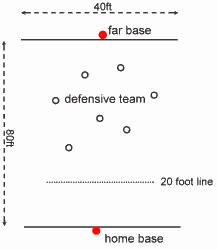 Gather from 10 to 30 scouts. Gather from 10 to 30 scouts.Lay out a play area about 40ft wide by 80ft long. Place a cone or base in the center of one end as home base. Place a cone in the center of the far end as the far base. Divide the group in half or have patrols play against each other. One team takes the field and distributes themselves anywhere past the 20foot line. First scout on the other team tosses and hits the volleyball or kicks the soccer ball into the field. If it does not cross the 20foot line, give a second chance. If that fails, the scout is out. The goal is to run around the far base and back without being hit by the ball. The scout can run anywhere within the play boundaries. If a defensive player catches a fly ball, the runner is out. The defensive team tries to hit the runner below the shoulders with the ball if it is not caught on the fly. A defensive player can only take two steps with the ball and can hold the ball for no more than 5 seconds. Score 1 point for each round trip. When 3 players are out, switch sides. |
Find more Scouting Resources at BoyScoutTrail.com
Beachball Ballyhoo | |
| Intended for: | All Scouts |
| Required: | 1 large beach ball per patrol |
| Instructions: | Each patrol has a beach ball that they hit into the air as many times as they can without it touching the ground. No one may hit the ball twice in a row. Count one point per hit and try for new records. Optional Competition:
|
Find more Scouting Resources at BoyScoutTrail.com
Benchball | |
| Intended for: | Scouts BSA |
| Required: | 2 benchs 1 or more volleyballs, rubber balls, or nerf balls |
| Preparation: | Lay out a rectangular play area such as a basketball court. Place a bench at each end. Mark a goalkeeper-only zone around the bench to keep opposing players from being too close. |
| Instructions: | There are many alternate versions of this game. General Play:
Alternative Rules to Mix In:
|
Find more Scouting Resources at BoyScoutTrail.com
Bicycle Races | |
| Intended for: | All Scouts |
| Required: | bicycles marbles 4 coffee cans per patrol chalk |
| Instructions: | Slalom Race: Set the 4 cans 6 feet apart in a straight line. Mark a starting line. Rider cycles from the starting line weaving between the cans, around the last can, and back to the starting line. Next scout rides. If a rider touches a can or touches the ground, they must start the ride over. Fastest patrol time wins. Marble Drop: Draw a starting line. Place the cans in a straight line 8-10 feet apart. Each scout gets 4 marbles. Scout rides past the cans and drops a marble in each one. Score one point per marble. Lose one point for touching the ground or a can. Not a timed race. Turtle Relay: Using chalk, draw a 3foot wide path about 50 feet long. Mark the ends of the path with chalk. Split the team in half with half at each end of the path. Using one bike, a scout rides from one end of the path to the other as SLOWLY as possible. When the front tire crosses the end line, time is stopped until the next scout starts the ride. Time is deducted for touching the ground or having a tire touch the path edges. Slowest patrol wins. |
Find more Scouting Resources at BoyScoutTrail.com
Birds of a Feather | |
| Intended for: | All Scouts |
| Required: | Slips of paper with a bird name written on each one - chicken, turkey, goose, duck, chickadee, crow. If you have 24 people, make 4 of each. If 42, make 7 of each. |
| Preparation: | Hand out a paper slip to each scout. |
| Notes: | Since the groups constantly change, there is no real team that wins. It should only take about three minutes to get a winner so many rounds can be played. If you are going to give out any small prizes, do it right after the round since you'll have no idea who gets the prize later. |
| Instructions: | On 'GO' signal, scouts mill about the room exchanging slips as many times as they can with as many different scouts as possible. They do not look at what is written on the paper. On 'STOP' signal, scouts stop and look at their paper. On 'FIND YOUR FLOCK' signal, scouts try to find all others of their kind and then sit down together. The last group to sit is out, taking their papers with them. Repeat until only one flock is left. Alternate: When finding your flock, you can only make the noise of the bird you have, no talking. Alternate: Use any animals rather than just these birds. |
Find more Scouting Resources at BoyScoutTrail.com
Bizz Buzz | |
| Intended for: | All Scouts |
| Notes: | Improve mental quickness and concentration. Good for a filler while sitting around. |
| Instructions: | Group sits in circle facing in. In a clock-wise direction, scouts count up from 1. Instead of 7 and all multiples of 7, and all numbers that contain 7, say 'Buzz'. For example, 1, 2, 3, 4, 5, 6, Buzz, 8, 9, 10, 11, 12, 13, Buzz, 15, 16, Buzz, 18, ... If there is a mistake, start over at 1 with the next scout in line. Once it is going well and the group has reached 50 or so, stop them and add 'Bizz' to the game. Now, substitute 'Bizz' for 5. For example, 1, 2, 3, 4, Bizz, 6, Buzz, 8, 9, Bizz, 11, 12, 13, Buzz, Bizz, 16, Buzz, 18, 19, Bizz, Buzz, 22, ... If the number is a multiple of 5 and 7, or has 5 and 7 in it, like 35 or 57 or 70 or 75, say 'BizzBuzz'! Try for a group record or reaching 100. Eliminate scouts that make mistakes until only the champion is left. |
Find more Scouting Resources at BoyScoutTrail.com
Blind Balloon Volleyball | |
| Intended for: | All Scouts |
| Required: | rope plastic tarp 6 or so balloons |
| Preparation: | String the rope between two trees or two posts - at least a foot higher than the tallest scouts. Drape the plastic tarp over the rope so teams can not see each other. Mark court boundaries on the ground. |
| Instructions: | Divide into two teams. Object is to make the balloon touch the ground on the other team's side. Start a balloon on one side of the court. A team can hit the balloon as many times as they want before hitting it over the net. Add another balloon after scouts get the hang of it. Add more balloons if the skill level warrants them. |
Find more Scouting Resources at BoyScoutTrail.com
Blind Birds | |
| Intended for: | All Scouts, Cub Scouts |
| Required: | whistle for each patrol large paper bag for each scout |
| Instructions: | Give to each patrol leader a whistle and a bag for each scout in his patrol. Tell the patrol leaders to return to their patrols and develop a unique whistle blast that their patrol will recognize. All scouts sit together in a mass at one end of the play area. All scouts except the patrol leaders put bags over their heads so they are blinded. The game leader calls all patrol leaders to the other end of the play area and arranges them spread far apart. On signal, all patrol leaders start blowing their secret whistle blast to attract their blind birds to be the first with all its members gathered. |
Find more Scouting Resources at BoyScoutTrail.com
Blind Observations | |
| Intended for: | All Scouts |
| Required: | Per scout: blindfold paper pencil Various other items |
| Preparation: | Give each scout a paper and pencil |
| Instructions: | Group into patrols, sit down, and blindfold everyone.
|
Find more Scouting Resources at BoyScoutTrail.com
Blind Referee | |
| Intended for: | All Scouts |
| Required: | large rubber ball or nerf ball whistle blindfold |
| Preparation: | Divide into two teams. Have one non-blindfolded referee right on the center line to judge points. |
| Instructions: | One team on each side of the center line. The ball is placed on the center line. One person is blindfolded and given the whistle. When the blindfolded person blows the whistle, the game begins. When the whistle is blown again, whichever side of the center line the ball is on receives one point - even if the ball is in the air and has not touched ground on that side. Play resumes when the whistle is blown again. The team with the fewest points after a set time limit wins - 3 minutes. Mix teams after a few rounds if it is very one-sided. |
Find more Scouting Resources at BoyScoutTrail.com
Blind Tazers | |
| Intended for: | All Scouts |
| Required: | 2 blindfolds 2 12-inch rolled up newspapers, ducttaped |
| Notes: | good indoor game for 12 or fewer people |
| Instructions: | Place two rolled up newspapers in center of play area. These are tazers, swords, clubs, whatever you want. Blindfold two scouts and have them stand opposite each other at edge or corners of area. On 'Go' signal, the two scouts are spun around three times and sat down facing the center. They crawl to the center to locate a tazer. Once a scout has a tazer, try to tag the other scout with it. First scout to touch the other with a tazer wins, whether purposefully or accidentally. Players must stay on knees (no standing). Each tazer has a safety switch so it must be in your hand when touching your opponent (no throwing). Observers should form the play area and redirect players towards the center and away from bumping into obstacles. Directions and support from the sidelines is encouraged (keeps everyone involved). |
Find more Scouting Resources at BoyScoutTrail.com
Blob Tag | |
| Intended for: | All Scouts |
| Instructions: | Three scouts join hands and start out as the 'Blob' and they try to tag other scouts. When tagged, a scout joins the blob by grabbing the last hand in line. When the blob has at least 6 scouts, it can break into two 3-scout blobs. The blob can break and join whenever it wants, depending on the plan being tried. Last 3 scouts begin the next round as the blob. |
Find more Scouting Resources at BoyScoutTrail.com
Bogus Baseball | |
| Intended for: | All Scouts |
| Required: | volleyball or soccer ball |
| Instructions: | Play on a baseball diamond or define the fair zone for hitting the ball. Divide scouts into two teams. Outfield team disperses where they hope to catch or stop the ball. The team at bat lines up about 15 feet behind home plate. The first scout stands at home plate with the ball. This scout tosses the ball up and hits it with a fist out into the field. As soon as it is hit, the scout begins running around and around the lined up team, counting the trips. In the field, whoever gets the ball first is the starting point and everyone on that team runs there and lines up behind that scout. The scout with the ball passes it between their legs to the scout behind, who passes it on. When the last scout in line gets the ball, they hold it up and the team yells "Yer OUT!". The team at bat scores one point for every time the batter circled the team. After three batters, teams switch position. Play continues for as many innings as time permits, or to a set score, or set number at bats. |
Find more Scouting Resources at BoyScoutTrail.com
British Bulldog | |
| Intended for: | Scouts BSA |
| Notes: | This gets VERY physical. You may want to address your larger scouts aside before the game about handling smaller scouts. |
| Instructions: | One scout is the 'bulldog' and stands in the center of the play area. Everyone lines up at one end of play area. When the bulldog yells, 'British Bulldog', all scouts run to the far end of the play area, avoiding the bulldog. To capture someone, the bulldog must lift the player completely off the ground long enough to yell, '1, 2, 3, British Bulldog!' That player then becomes a bulldog too. The last player caught is the bulldog for the next round. |
Find more Scouting Resources at BoyScoutTrail.com
Bubble Gum Relay | |
| Intended for: | All Scouts |
| Required: | 12 pieces of bubblegum or chewing gum for each patrol 1 paper grocery bag for each patrol 1 pair of work gloves for each patrol |
| Instructions: | Patrols line up in single file at the starting line. A closed bag containing gum and gloves is placed 20 or 30 feet away from each patrol. The first player on each team runs to the bag, opens it, puts on the gloves, digs down into the bag for the gum, pulls it out, unwraps it and starts chewing it. The player then replaces the gloves in the bag, closes the bag, and runs back to tag the next in line. Continue doing this until all the gum in the patrol's bag is gone - some scouts will do more than one trip. If using bubblegum, the first patrol to be in line with each scout blowing a bubble at the same time wins. Otherwise, the first patrol to have all members back in line wins. |
Find more Scouting Resources at BoyScoutTrail.com
Bucket Ball | |
| Intended for: | Scouts BSA |
| Required: | two cardboard boxes, bushel baskets, or plastic clothes baskets a basketball gym floor or flat surface |
| Notes: | sportsmanship, teamwork |
| Instructions: | Use the buckets as baskets. Play basketball as normal but the ball must stay in the bucket to score. Optional: Have each patrol be a team. When one team scores, the scored-on team is replaced with a fresh team. |
Find more Scouting Resources at BoyScoutTrail.com
Build It | |
| Intended for: | All Scouts |
| Required: | blocks, scraps of wood, twine, sticks, ... any materials with which to build. |
| Instructions: | Make a pile of materials for each team. Each team has 2 minutes to inspect their materials, without touching anything. They also need to decide what they are going to build. Then, each team has 3 minutes to build their structure, without talking. Be sure to explain all the rules before they start so they can make a plan on how they will accomplish their goal. After the game, discuss how teams communicated without talking. Did someone just take over or did everyone co-operate? What would they do differently if they tried again? |
Find more Scouting Resources at BoyScoutTrail.com
Can Stack | |
| Intended for: | All Scouts |
| Required: | 10 cans per patrol |
| Instructions: | A pile of 10 cans is set at the start line for each patrol. These can be soda cans, soup cans, tuna cans, but all need to be the same size. On 'GO', the first scout for each patrol takes one can and runs to the end of the play area, sets the can on end, and returns to tag the next scout. Each scout in turn takes one can and stacks it onto those currently stacked, creating a stack with no more than 4 cans on the bottom layer. If at any time the stack falls over, the entire patrol can run to it and return all the cans to their original pile - only one can per scout. Then, they start over moving one can at a time. First patrol to complete their stack and return to the starting line wins. |
Find more Scouting Resources at BoyScoutTrail.com
Candle Relay | |
| Intended for: | Scouts BSA, Webelos Scouts |
| Required: | candle and box of matches for each team |
| Preparation: | Define starting line and turn-around point. |
| Instructions: | Patrols line up single file. Each patrol leader is given a candle and box of matches. On go signal, patrol leader lights candle and runs the course. When the player gets back, hand off the candle and matches to the next scout. If the candle goes out, the scout must stop and relight it. Each patrol makes the number of round-trips as there are players in the largest patrol. Make it more interesting by having random tasks pulled from a bag - walk backwards, crawl, hop, hold candle above head or below knee, ... |
Find more Scouting Resources at BoyScoutTrail.com
Candy Dice | |
| Intended for: | All Scouts |
| Required: | lots of m&ms or other small candies one dice |
| Notes: | This is a simple filler game with no skill required |
| Instructions: | Break into groups of 4 to 8 players, sitting in a circle. In the center of the circle put a pile of candies. One player rolls the dice. If it is a 6, the roller gets a candy. The dice passes to the right. As each scout rolls, if it is not a 6, the last scout that rolled a 6 gets another piece of candy. If it IS a 6, the roller gets a candy and becomes the 'candy collector' until someone else gets a 6. |
Find more Scouting Resources at BoyScoutTrail.com
Canoes and Compasses | |
| Intended for: | Scouts BSA |
| Required: | Canoe, 3 life jackets, 2 paddles, compass, and blanket for each team of 3 scouts |
| Notes: | If you make this a timed race, there is more chance of collisions in the water. |
| Instructions: | Set up some numbered buoys at least 100 feet from the shore of a lake, about 20 feet apart. Set up a starting point on shore for each team. From one starting point, take compass bearings to each buoy and write down the bearing for each numbered buoy. Also, write down the bearing on a separate slip of paper and put all these slips in a bag at the starting point. Repeat this for each starting point. A team of 3 scouts gets ready in a canoe. Two of the scouts are paddlers, and the third kneels in the middle, under a blanket, holding a flashlight and a compass. When the canoe is ready to go, the activity leader gives a slip of paper to the scout under the blanket. The slip of paper has a compass bearing written on it. When the activity leader starts the game, the paddlers paddle the canoe toward the buoys based on the directions given by the scout under the blanket. The navigator under the blanket should tell them to turn 'port' or 'starboard' as needed. When the canoe reaches a buoy, the number of the buoy is recorded on the slip of paper and the team returns for the next slip. The activity leader on shore takes the completed slip and gives the navigator the next slip from the bag. Repeat as many times as you have time for. |
Find more Scouting Resources at BoyScoutTrail.com
Capture the Flag | |
| Intended for: | All Scouts |
| Required: | flag for each team. 40 foot rope per team. |
| Preparation: | Set up game boundaries with a center line. A football field sized area is good. |
| Instructions: | Create 2 teams. Each team displays its flag in plain view somewhere on its side of the play field. Each team also defines a jail area that is 10x10 feet - use a rope to define the area. Players attempt to steal the opposing team's flag and return it to their side of the center line without being tagged. If a scout has the flag and is tagged, the flag is dropped and remains there until another opposing player can steal it. The scout that is tagged is taken to the jail area by the captor. During this time, the captor can not capture any other players and the captive must go directly with the captor. Once in jail, a scout remains there until another teammate can run into the jail area without being tagged - this is a jailbreak. Decide if a jailbreak allows all captured scouts a free walk to their side or a certain number only. |
Find more Scouting Resources at BoyScoutTrail.com
Capture the Fort | |
| Intended for: | Scouts BSA, Webelos Scouts |
| Required: | soccer ball or NERF ball |
| Instructions: | At least 7 scouts per team. One team stands in a circle facing outward. Each scout places their left hand on the right shoulder of their neighbor and must keep it there. The team leader stands in the center of the circle. This is the fort. The other team spreads out outside the fort. These are the attackers. The soccer ball is a bomb. The leader drops the bomb to the attackers. They try to kick the bomb through the holes in the fort wall - between legs or between bodies. Or, they can kick it over the top of the wall. If the bomb touches the ground inside the fort, it explodes. The team leader in the fort can catch the bomb and throw it back before it touches the ground. The walls can use their bodies or right hand to deflect the bomb. Either switch sides after each explosion or after a set time limit. |
Find more Scouting Resources at BoyScoutTrail.com
Catch 10 | |
| Intended for: | Scouts BSA |
| Required: | a ball neckerchiefs or ribbons |
| Preparation: | define the playing field - basketball court size is good. Divide group into 2 teams. Put neckerchiefs on 1 team's arm for identification. |
| Instructions: | One team starts with the ball. It is thrown to another teammate who yells "One!" At each successful catch, the next number is yelled. When a team reaches "Ten!" they receive one point. The other team tries to intercept the ball or knock it to the ground. On an interception, the scout yells "One!" and their team is now counting up. Whenever the ball hits the ground, the team that was last counting loses control and the other team picks it up and starts counting up. The only physical contact should be incidental while going for the ball. Set a time limit or first team to a specific score. |
Find more Scouting Resources at BoyScoutTrail.com
Catch Up | |
| Intended for: | All Scouts |
| Required: | two basketballs or rubber balls or any balls |
| Instructions: | There must be an even number of scouts. All participants stand in a circle facing inward. Number off 1-2-1-2-1-2... This creates two even teams. Give one ball to a scout on team #1. Tell the scout to pass it to the next player on their team to the right. Let that team pass the ball all the way around the circle for practice. Then, give that ball to team #2 and let them practice around once. Now, give a second ball to the player on team #1 directly opposite the team #2 player that has their ball. On 'GO', players pass the ball to their teammate on their right with the goal of catching up to the ball of the opposing team. If the ball is dropped, the last scout on that team that touched it has to retrieve it, retun to the correct spot, and throw it again. Score a point when you catch up to the other team and then start another round. Try going to the left for a change. Try bounce passing for a change. |
Find more Scouting Resources at BoyScoutTrail.com
Chain Gang Escape | |
| Intended for: | Scouts BSA |
| Required: | rope for each scout - about 6 feet |
| Preparation: | Define starting line for each patrol. Pile ropes for each patrol about 20 feet from the line. Define finish line about 50 feet away. |
| Notes: | knot tying, patrol teamwork. |
| Instructions: | Your gang is being held unjustly in a state prison. The only way to escape is to get out of the prison yard by working on the chain gang and then making a run for it. Since this is a jail break, absolute quiet is needed. A 5 second penalty is added for each instance of talking. Each patrol lines up in single file. On 'Go' signal, each patrol leader runs to their ropes, picks them up, and returns. The patrol leader takes one rope and passes the rest back so each scout gets a rope. The patrol leader ties a bowline knot in the rope, and slips it around an ankle. The patrol leader passes the end of the rope to the next scout who ties a rope to it with a square knot. That scout then ties the rope around an ankle using a clove hitch and passes the end to the next scout. Repeat this all the way to the last scout. The last scout ties a rope on and then makes a bowline and slips it over an ankle. The last scout quietly signals the leader that the chain is complete. The entire patrol runs together to the state line (finish line) where they are safe. A referee checks all knots for correctness. Incorrect knots get a 10 second penalty. Broken knots get a 15 second penalty. Fastest patrol after adding time penalties wins. |
Find more Scouting Resources at BoyScoutTrail.com
Chicken Run | |
| Intended for: | All Scouts |
| Required: | rubber chicken (or large bean bag) |
| Instructions: | Make two teams. Leader of first team throws chicken as far as possible and yells CHICKEN RUN! The team then bunches into as small a group as they can except for one scout who is the 'runner'. The runner runs around and around the group as fast as possible, yelling out the number of laps completed. Meanwhile, the other team runs to where the chicken landed and forms a line facing the chicken. The leader picks up the chicken and hands it over a shoulder to the scout behind. That scout hands it between legs to the next scout behind. This is repeated over-under all the way to the last scout in line. When the last scout gets the chicken, it gets thrown as far as possible and the scout yells CHICKEN RUN! The teams switch roles running in circles and chasing the chicken for a set time limit. The team with the most laps wins. May have rule that each scout can only be a runner or thrower once during a game. |
Find more Scouting Resources at BoyScoutTrail.com
Clothespin Tag | |
| Intended for: | All Scouts |
| Required: | lots of clothespins |
| Instructions: | Give every scout a handful of clothespins to pin anywhere on their clothes where they can be reached by other scouts. On 'Go' signal, everyone tries to pull a clothespin off someone else. As soon as a clothespin is snatched, the scout that stole it kneels down and pins on the clothespin. While kneeling, a scout is safe from having a clothespin taken. Set a time limit and see who (or which team) has the most clothespins when time is called. You may need to set rules to prevent kneeling too long or kneeling without first snatching a clothespin. |
Find more Scouting Resources at BoyScoutTrail.com
Clue | |
| Intended for: | Scouts BSA |
| Required: | 3 pieces of paper and pencil for each scout. 3 paper bags. |
| Instructions: | Similar to the boardgame of Clue!, in this game, each scout needs to combine a victim, location, and weapon to kill off another scout. This game may take days to complete so it should be ongoing as part of a weekend retreat or week-long camp. To start, give each scout 3 pieces of paper and a pencil. Have each scout print their name on one piece of paper. Have each scout print a weapon, such as 'pencil', 'pinecone', 'wristwatch', ... on the 2nd piece of paper. Have each scout print a location around the campground or building on the last piece of paper - 'bathroom', 'firepit', 'front door', ... Put all the names in one paper bag, all the weapons in another, and all the locations in the third. Have each scout pull a name, a weapon, and a location. Check the name immediately - if it's your own name, draw again. Everyone must keep their three pieces of paper with them at all times. If this is not practical, they need to memorize the three items and play by honor. Each player's goal is to get their weapon and victim to their location and announce to them that they've been eliminated or show them the papers. This 'kills off' that player. The 'killer' inherits that scout's three pieces of paper and plans the next attack. The last scout left, or the scout who killed off the most players when time runs out, is the winner. |
Find more Scouting Resources at BoyScoutTrail.com
Code Relay | |
| Intended for: | Scouts BSA |
| Required: | paper and pencil for each patrol |
| Instructions: | Need an open field up to 200 yards long, depending on patrol sizes. Create a simple code for numbers equaling letters, such as the example below. One leader is the Code Keeper. Create coded messages - one for each patrol, but all should have about the same number of letters. Possibly easier for younger patrols, such as duplicated letters or slightly shorter messages. All patrol leaders gather with the game leader at one spot. 20 yards away stands another scout of each patrol. 20 yards farther stands another scout. And so on for as many scouts as are in the largest patrol. The last scout in each patrol needs a paper and pencil. 20 yards past this last scout stands the Code Keeper with the simple code. To start the game, each patrol leader is given the patrol's coded message. As soon as the patrol leader gets the message, the teammate 20 yards away runs to the patrol leader. The patrol leader tells as many of the numbers as he wants to the scout. The scout runs back to his starting point while the next in line runs to meet him. He relays the numbers then returns to the patrol leader for more numbers. The 2nd scout relays to the 3rd and so on until the last scout gets the numbers. The last runs to the Code Keeper and tells each number. For each number, the Code Keeper says the corresponding letter which he writes down. When the patrol has all the numbers transferred and decoded, the entire patrol gathers at the patrol leader and yells out the message in unison. Patrols with fewer scouts have less chance to mis-translate, but the last scout must run farther to the Code Keeper. Patrols may try to memorize many numbers or do them one at a time to be safe. An example message (each scout would run a little over 1/3 mile) 17, 21, 17, 10, 7, 7, 6, 21, 8, 13, 21, 8, 3, 13, 21, 19 W E W I L L B E P R E P A R E D An example Code: A - 3 B - 6 C - 9 D - 19 E - 21 F - 22 G - 14 H - 1 I - 10 J - 23 K - 4 L - 7 M - 11 N - 2 O - 5 P - 8 Q - 12 R - 13 S - 25 T - 18 U - 15 V - 16 W - 17 X - 20 Y - 26 Z - 24 |
Find more Scouting Resources at BoyScoutTrail.com
Collection of Silly Races | |
| Intended for: | All Scouts |
| Required: | newspaper or sheets of paper |
| Instructions: | Newspaper Race - Two newspaper sheets required per player. Each scout must race to the turning point and back, stepping only on newspapers with both feet - step on one, lay the other in front, step on it, move the first forward, and step on it and so on. No Hands Get Up - Scouts run to turning point, stop, lie down on their backs, fold hands across chest and get up without moving their arms, and run back to finish line. Toe and Heel - Runner advances by placing one foot in front of the other so that the heel of the advancing foot touches the toes of the hind foot. |
Find more Scouting Resources at BoyScoutTrail.com
Compass & Map Relay | |
| Intended for: | Scouts BSA |
| Required: | For each patrol: compass, map, pencil, 8-12 index cards. |
| Preparation: | On each index card write the names of 2 towns or easily identified features of the map. Copy these cards for each patrol. |
| Notes: | practice map reading, orienting a compass. |
| Instructions: | Patrols line up single file. Place the cards and pencil for each patrol about 20 feet away from the start line. Give a compass and map to each patrol leader. On 'Go' signal, patrol leader will run out and pick a card. Locate the two points on the map and plot a bearing from the first point to the second. Write the patrol name and bearing on the card and take it to the judge. Run back to hand the compass and map to the next scout in line. Repeat for each scout. |
Find more Scouting Resources at BoyScoutTrail.com
Compass Reading | |
| Intended for: | Scouts BSA |
| Required: | compass, paper, and pencil for each scout 8-10 stakes in the ground with arrow markers stapled to top. |
| Preparation: | Place the stakes out in the play area so that each arrow points at a distant object. Write a number on the stake or marker on top - 1 through 10. Each scout should write the numbers 1-10 on a paper, with 3 lines empty between numbers. |
| Notes: | Good for newer scouts to build compass experience. |
| Instructions: | Set a time limit of 6-8 minutes. On 'GO' signal, scouts go to any stake they want. At each stake, write down what object they believe the arrow is pointing at by the corresponding number on their paper. Then, figure the bearing from the stake to that object and write it down. (Or, just find the bearing of the arrow on the marker) When all stakes have been done or when time is called, each scout turns their paper into the judge for scoring. |
Find more Scouting Resources at BoyScoutTrail.com
Complicated Tag | |
| Intended for: | All Scouts |
| Required: | a few rubber dodgeballs |
| Preparation: | Mark off a large playing area - at least 15 yards by 15 yards, larger for bigger groups. |
| Instructions: | The goal is to be the last scout eliminated. There are 3 ways to be eliminated:
When you are eliminated, you immediately sit down right where you are. You may no longer move from your waist down. You can still participate in the game in three ways. If you do one of these, then the other scout is eliminated and you get to stand and move again:
You may need to create rules for:
|
Find more Scouting Resources at BoyScoutTrail.com
Conquer Liechtenstein | |
| Intended for: | Scouts BSA |
| Required: | 5x5 foot mat or 6 foot diameter circle marked on ground |
| Instructions: | (Liechtenstein is a tiny country of 62 square miles in Europe.) Explain that the target area is Liechtenstein and their 'army' needs to conquer the territory and expel any opposition. Divide group into two teams. Teams start on opposite sides of Liechtenstein about 20 feet away. On 'Go' signal, teams race to Liechtenstein and try to get as many of their teammates in the target area as possible while keeping off the other team members. After 30-45 seconds, the team leader blows a whistle or gives 'STOP' signal. The team with the most members in Liechtenstein wins that round. Have teams regroup, strategize, and play again. People can be pulled or pushed, but you might need to add a rule that no clothes can be grabbed. |
Find more Scouting Resources at BoyScoutTrail.com
Counting Coup | |
| Intended for: | All Scouts |
| Required: | 1 or 2 patrols blindfold markers such as paper squares or pennies for each scout |
| Instructions: | One scout is the Indian Chief blindfolded in the center of a circle. All other scouts stand outside the circle and one at a time stalk up to the chief attempting to count coup by touching the chief. If the Chief hears anything, he yells 'STOP' and the stalker must immediately freeze. The Chief points exactly where he thinks the creeping enemy is. The referee decides if the Chief was correct or not. The stalker must go by the referee's decision. If the Chief is correct, the stalker leaves a marker on the ground where the closest toe was resting and leaves the circle. If the chief is incorrect, the stalker continues on until caught or successfully touches the Chief's arm, which makes the stalker the new Chief. If no one touches the Chief, the closest one is chief next. Variation: Have two patrols against each other. Each patrol leader is the chief for a patrol. First have one patrol try to count coup. For every scout that reaches the Chief, the patrol gets 1 point. Leave markers on the ground for those that are detected. After each patrol goes, the one with the most coup counted wins. If none reached either chief, compare the closest markers from each patrol, then the next closest pairs, ... giving one point for the closest of each pair. |
Find more Scouting Resources at BoyScoutTrail.com
Crab Fights | |
| Intended for: | All Scouts |
| Instructions: | Everyone gets in crab position - on hands and knees with rear underneath. (Bear position is rear up in the air). On 'Go' signal, everyone tries to get other crabs to touch their rear to the ground. The last crab up, wins. Referees are needed to determine when a rear hits the ground. Could have a patrol competition. Could have a 'Patrol Leaders' round to see which patrol has the crabbiest leader. Alternative: have each patrol lined up on the play area border at different locations. The first scout in each patrol crabs into the fight. When a scout is knocked down, the patrol gets 1 point, and the next scout in the patrol crabs in. The patrol with the fewest points wins. Patrols of smaller scouts will hopefully figure out alliances to combat larger scouts. |
Find more Scouting Resources at BoyScoutTrail.com
Crabs, Crows, and Cranes | |
| Intended for: | All Scouts |
| Preparation: | Draw two goal lines about 50 or more feet apart. You may want to define sidelines as well. |
| Notes: | See Giants, Elfs, and Wizards for a similar game. |
| Instructions: | Split group in half. Each team forms a shoulder to shoulder line facing the other team at midfield, about 10 feet apart. Name one team the 'Crows'. Name the other team the 'Cranes'. When the leader yells 'CROWS!', the Crows must run back across their goal line without being tagged by a pursuing Crane. If tagged, the scout stops and joins the Cranes for the next run. When 'CRANES!' is yelled, the pursuit is reversed. When 'CRABS!' is yelled, everyone should stay still - anyone that moves is transferred to the other team. The game ends when all people are on the same team and either the Crows or Cranes are extinct. |
Find more Scouting Resources at BoyScoutTrail.com
Crack the Cracker | |
| Intended for: | All Scouts |
| Required: | broomstick or long pole. one long thread for each patrol 5 or 6 saltine crackers for each patrol |
| Preparation: | Tie a cracker to the end of a string by threading the thread through a hole in the cracker and tieing it. Tie another cracker to the thread about 6 inches above the first. Repeat for all crackers and then tie the thread to the broom. |
| Notes: | This is a fun competition that takes just a minute or two but makes a big mess. |
| Instructions: | Call up a volunteer for each patrol. The rest of each patrol will be cheering on their scout. Have two unbiased volunteers hold up the broomstick so the shortest scout will be able to reach the highest cracker with their mouth. Have the scouts line up behind the broomstick, facing the audience. Have one scout lined up behind each string of crackers. Have each scout clasp their hands behind their back. Objective: Using only your mouth, be the first scout to crack all your crackers off the string. You don't have to eat them, but the string needs to be completely clean. Alternative: Have each scout run up and crack one cracker on their patrol's string, then return and tag the next scout. This gets more scouts involved rather than watching. |
Find more Scouting Resources at BoyScoutTrail.com
Crocodile | |
| Intended for: | All Scouts |
| Preparation: | Mark the two banks of a river on the floor. |
| Instructions: | Split the group in half. One half goes to each side of the river. One scout is the crocodile in the river. Number off all people on each team. The crocodile calls out a number and the scout from each team with that number must run to the far bank without being tagged. If the crocodile tags someone, they switch places. If a scout does not leave the bank before the other running scout reaches the bank, then that slow scout switches places with the crocodile. This is to keep the game moving. No scoring, just for fun. |
Find more Scouting Resources at BoyScoutTrail.com
Defender | |
| Intended for: | All Scouts |
| Required: | three balls (tennis, foam, or rubber) three towers (tin cans, plastic bottles, or similar) |
| Instructions: | Draw or use rope to define a 20ft diameter circle on the floor or ground. In the center, one scout sets up the three towers however desired. All other scouts stand outside the circle with the three balls. On 'Go', everyone tries to knock over the towers. The defender stands up knocked over towers as fast as possible. If all three towers are knocked down, the scout that threw the ball that knocked the last one over becomes the defender. No one really 'wins'. The goal is the glory of being the defender for the longest time. You may say the defender can not interfere with thrown balls, or can try to block them. You may say one attacker can enter the ring to retrieve a dead ball, or when all balls are dead the defender tosses them all outside the ring to renew the game. |
Find more Scouting Resources at BoyScoutTrail.com
Dissolving Necklaces | |
| Intended for: | All Scouts |
| Required: | for each scout: - alka-seltzer tablet - 18-inch string - plastic baggie |
| Preparation: | Poke a hole through a tablet and thread it on a string. Tie to make a necklace. |
| Instructions: | This game is for hot summer days and can be played in shallow water, on a beach, or anyplace where there is a water supply. Participants should wear swimsuits. Each scout puts on their necklace and fills their baggie with water. When the judge says, "GO!" everyone tries to spray the necklace of other scouts while keeping their own necklace dry. The tablets will dissolve when they get wet. When a scout's tablet dissolves, that scout is out of the game and goes to a designated area. Can play in teams or free for all. If not at a beach, the water supply should have a boundary around it inside of which is a free-zone for filling baggies. Also have a rule against staying in the free-zone for too long. By partially closing the baggie, it can shoot a good stream of water. |
Find more Scouting Resources at BoyScoutTrail.com
Ditchem | |
| Intended for: | All Scouts |
| Notes: | game for a large group over a wide area |
| Instructions: | Identify the play area, which should be a large field or forested area. Identify a Jail Space for captured scouts. Divide the scouts into two teams. Team A has 1 minute for its scouts to hide anywhere in the designated play area while Team B has their eyes shut. A signal is given, and Team B spreads out, searching for hiding scouts. Found scouts must be tagged - rougher versions require being tackled - to be captured. Captured scouts are led to the Jail Space where they must stay - rougher versions allow captured scouts to attempt escape on the way to jail, but never once placed in the jail. Once in jail, the scout can be rescued by having a teammate run to the jail area and tag the jailed scout. The Jail can have as many guards as the searching team wants. The round is over when all hiding scouts are in jail. Then, teams switch roles and try again. |
Find more Scouting Resources at BoyScoutTrail.com
DodgeBall in a Circle | |
| Intended for: | All Scouts |
| Required: | 10 or more scouts 2 or more rubber dodgeballs or other safe balls |
| Instructions: | Draw large circle - 40 feet in diameter. All scouts are dodgers inside circle except for 1 or 2 scouts that are throwers. Throwers stay outside the circle and try to hit dodgers inside with a ball. If hit, a scout leaves the circle and becomes a thrower. Last one left wins. Hits above the waist do not count and that thrower sits out the next round as a consequence. Dodgers can not catch the balls. If a ball bounces before hitting a dodger, it does not count. Alternative: Have all members of one patrol inside the circle and everyone else are throwers outside. When somone is hit, they sit out. Repeat for every patrol and then have winners from each patrol in the circle to find the grand champion. |
Find more Scouting Resources at BoyScoutTrail.com
Duck the Staff | |
| Intended for: | Scouts BSA |
| Required: | staff for each team(or broomstick) |
| Instructions: | Each patrol lines up in single file with at least 10 feet between team lines. Each patrol leader is given a staff and stands about 5 feet in front of the patrol line, facing them. On 'GO' signal, the patrol leader tosses the staff with two hands to the first in line. Leader may need to demonstrate that the staff is tossed, not thrown point-first. The first in line tosses it back to the patrol leader and then ducks down - and hopefully keeps head covered. The patrol leader tosses the staff to the next in line and so on to the last in line. The last in line remains standing and the patrol leader tosses the staff a second time. Then, the next scout closer in line stands up and receives a toss and tosses it back. This is repeated until all teammates are again standing and the patrol leader throws the staff to the first in line. First patrol to go through the cycle and give a yell is the winner. The perceived danger makes the activity exciting, but being hit by a dropped staff is not harmful. As long as tosses are done with two hands and not point-first, there is no real danger. |
Find more Scouting Resources at BoyScoutTrail.com
Dungeon BreakOut | |
| Intended for: | Scouts BSA |
| Required: | blindfolds |
| Preparation: | Mark a starting line and a finish line about 25 feet away. |
| Instructions: | One patrol is blindfolded - they are the Dungeon Wall. They line up across the playfield at centerline with each scout's feet spread apart and touching the foot of the scout next to them. The other patrol is on the starting line and their job is to burrow under the Dungeon Wall and escape. The Dungeon Wall scouts have two booby traps that can spring and catch someone trying to escape - their hands which are held at shoulder height. When a Dungeon Wall player believes someone is trying to burrow through, the player can reach down with one hand to tag the burrower. If the burrower is touched, that player is captured and thrown in the castle tower and the booby trap can be reset. If there is no escapee there or is missed, then that booby trap is no longer usable and must be held behind the Wall player's back. After a set time, about 3 minutes, tally the number of escapes and captures and switch sides. One point for each escape and one point for each capture. The patrol with the most points wins. |
Find more Scouting Resources at BoyScoutTrail.com
Execution Dodgeball | |
| Intended for: | Scouts BSA |
| Required: | 2 large inflated rubber balls |
| Preparation: | Best played in a gym. Divide the play area in thirds. |
| Notes: | Alertness, quickness. |
| Instructions: | Divide group in half. Team #1 goes in the center third of the play area. Team #2 is divided in half, and half the team goes into each of the end areas. Team #2 throws balls at Team #1. When someone is hit below the shoulders, they join the end that threw the ball. (Possible rule is that if you hit someone in the head, you sit out the rest of the round.) Team #1 in the middle does not throw the balls - they just try to dodge and stay alive. The last two scouts in the middle section win and get to start with the balls in the next round. The original Team #1 members are now in the end sections while Team #2 is in the middle. |
Find more Scouting Resources at BoyScoutTrail.com
Exercise Relay | |
| Intended for: | All Scouts |
| Preparation: | For each team, write an exercise on a separate slip of paper and put in a bag or fold in half. Place papers at a point 30 feet or more from the team. |
| Instructions: | Each team needs an area in which to do exercises. Each team has a bag of paper slips about 30 feet from their area. On 'Go', the first scout of each team runs to their bag, pulls out one slip of paper, and runs back to the team. Everyone on the team performs the exercise. When the judge signals completion, the next scout runs to the bag, brings back a paper, and the team does it. Continue until the first team has completed a set number of exercises. Sample Exercises:
|
Find more Scouting Resources at BoyScoutTrail.com
Falling Staffs | |
| Intended for: | Scouts BSA |
| Required: | a scout staff or 5-foot pole for each scout |
| Instructions: | Everyone stands in a circle, facing inward, with their staff standing on end directly in front of them. The leader gives a command of "Ready - Right" and everyone must let go of their staff and move to the right, grabbing that staff before it falls. Or, "Ready - Left" and scouts go to the left. If someone fails to catch the target staff, they and the staff are out. When someone moves the wrong way, a collision may occur and remove two scouts at once. When two are left, they are declared winners or can use some 1-on-1 contest, such as Rock-Paper-Scissor, to determine the ultimate champ. |
Find more Scouting Resources at BoyScoutTrail.com
Famous Visitor | |
| Intended for: | Scouts BSA, Bear Scouts, Webelos Scouts |
| Notes: | Improve deduction skills |
| Instructions: | Each patrol goes to a separate area as far away from the other patrols as possible to prevent accidental eavesdropping. Each patrol leader comes to the game leader and is told the name of the famous person for this round. Each patrol leader goes to a patrol other than their own and the patrol asks Yes-No questions to figure out who he is. The first patrol to yell out the correct name wins 1 point. The patrol of the scout answering the questions for that team also receives 1 point. After a number of rounds, the patrol with the most points wins. Alternative: As a single team, work together in trying to guess the identities as quickly as possible. |
Find more Scouting Resources at BoyScoutTrail.com
Fight for Attention | |
| Intended for: | Scouts BSA |
| Notes: | This is not an active game, but it can be quite entertaining. |
| Instructions: | Two scouts stand in the front of the troop. They are given a topic to talk about and 20 seconds to prepare. On GO signal, both scouts give a speech about their topic - at the same time - trying to keep the audience listening to their speech rather than the other speaker. At the end of one minute, or some set time, the audience votes for the one that held their attention best. Played as patrols, each win gets a point for your patrol. After every patrol has had four different scouts speak, the results are tallied. More than 6 patrols and it may start to get boring, since that is 12 speeches. |
Find more Scouting Resources at BoyScoutTrail.com
Finger Jousting | |
| Intended for: | All Scouts |
| Instructions: | This is a great game to pass the time before a meeting, or any time. It just takes two people of any size - a smaller, quick scout can often win over a stronger, larger opponent. Scouts face each other and clasp their right hands as if to arm wrestle, but with the index finger extended. The index finger is the Lance used to stab the opponent. On 'Go', the first scout to touch the other's body anyplace except on the right arm with the index finger receives a point. Read the basic rules and set up a Finger Jousting tournament! |
Find more Scouting Resources at BoyScoutTrail.com
Fire Brigade | |
| Intended for: | All Scouts |
| Required: | 1 full water bucket per team. 1 cone, stick, or marker per team. |
| Preparation: | Draw start line and place cone about 30-40 feet out from start. |
| Instructions: | Have patrols line up single file at start line. Each patrol leader is given bucket of water. On 'Go' signal, patrol leader runs out around cone and back to the end of the line. The bucket gets passed up the line to the first scout in line who runs around the cone. Repeat for 10 laps. The first patrol to complete 10 laps gets 15 points, second team gets 10 points, third team gets 6 points - minus 3 points for each 1/2 inch of water lost. Special 5 point bonus for the patrol with the most water remaining. |
Find more Scouting Resources at BoyScoutTrail.com
First Aid Relays | |
| Intended for: | Scouts BSA, Webelos Scouts |
| Notes: | These are a handful of different First Aid games that can be fun and useful. Make sure scouts have been taught the various skills before doing the games. |
| Instructions: | Fireman's Drag Relay: Two teams - half the members of each team are firemen, the other half are victims and are laying on their backs. On signal, the first fireman runs up to a victim, ties the wrists together with a neckerchief, and pulls the victim back to the starting line with the fireman's drag. Touch off the next fireman, who then rescues the next victim. First team to bring in all their victims wins. Two-Man Carry Relay: Number each scout on each team. #1 and #2 carry #3 using a four-hand seat carry for conscious victim to end and back. #2 and #3 carry #4. Continue through scouts. Next-to-Last and Last carry #1. Last and #1 carry #2. If a victim touches the ground, stop and do some penalty, re-form the carry and continue. Stretcher Relay: Need two staffs and a blanket for each team to create stretchers. Also need paper cups and water. #1 and #2 create a stretcher and carry #3 to end and take stretcher apart. Each scout brings back one piece of the stretcher. #2 and #3 carry #4. Continue through scouts. Next-to-Last and Last carry #1. Last and #1 carry #2. Bonus: Have the victim carry a paper cup of water. The team with the most water left gets a bonus. Arm Sling Relay: Teams line up in relay formation with one scout acting as victim and standing in front of the team 30 feet away. All other scouts have their neckerchiefs on properly. The first scout on each team runs to the victim, asks what is wrong, and applies an arm sling to the arm indicated. When the judge sees that the sling is correct, he calls out "Cured!". The scout removes the sling and becomes the victim. The previous victim runs back to touch the next member of the team. This continues until all on the team have been victim and rescuer. Pressure Pad Relay: Teams line up in relay formation with one scout acting as victim and sitting in front of the team 30 feet away. All other scouts have their neckerchiefs on properly. The first scout on each team runs to the victim, asks what is wrong, and applies a neckerchief folded into a pressure pad where indicated. When the judge sees that the pad is correct, he calls out "Cured!". The scout removes the pad and becomes the next bleeding victim. The previous victim runs back to touch the next member of the team and puts neckerchief back on. This continues until all on the team have been victim and rescuer. |
Find more Scouting Resources at BoyScoutTrail.com
First Class Relay | |
| Intended for: | Scouts BSA |
| Required: | pole per patrol rope per patrol kerchief per patrol ace bandage per patrol One adult per patrol as judge. |
| Notes: | Good reinforcement of skills required for First Class. Also a good review for older scouts since they tend to forget quite a bit without review. |
| Instructions: | This is a relay between patrols to demonstrate First Class skills and knowledge. The adult assigned to each patrol positions himself 10, 20, or 30 feet from the patrol. He has a list of Tenderfoot, 2nd Class, and 1st Class questions. Tenderfoot are worth 10 points, 2nd are worth 15, and 1st are worth 20. At the signal, each patrol leader runs to their patrol's judge and tells him what level question is wanted - Tenderfoot, 2nd, or 1st. The judge asks for a skill demonstration or answer to a question from that category. If the scout is successful, the judge checks off the question and the scout runs back to tag the next scout. If the scout is incorrect, the skill is not checked off and no points are earned. After a set time limit, the patrol with the most points wins. Or, the patrol to answer all questions first wins. Tenderfoot Skills Show the Scout Sign. Say the Scout Oath (make sure they use the Scout Sign). Say the Scout Law (make sure they use the Scout Sign). Say the Scout Motto. Say the Scout Slogan. What is your patrol name? What is your patrol yell? Describe your patrol flag. Tie two half hitches. Tie a tautline hitch. Describe treatment for simple cuts and scratches. Describe treatment for blisters on the hand and foot. Describe treatment for minor burns or scalds (first degree). Describe treatment for bites and stings of insects and ticks. Describe treatment for a poisonous snakebite. Describe treatment for a nosebleed. Describe treatment for frostbite. Describe treatment for sunburn. Second Class Skills When is it appropriate to use a cooking fire? When is it appropriate to use a lightweight stove? Describe treatment for stopped breathing. Describe treatment for serious bleeding. Describe treatment for internal poisoning. Describe treatment for an object in the eye. Describe treatment for a bite of a suspected rabid animal. Describe treatment for puncture wounds from a splinter. Describe treatment for puncture wounds from a nail. Describe treatment for puncture wounds from a fishhook. Describe treatment for serious burns (second degree). Describe treatment for heat exhaustion. Describe treatment for shock. Describe treatment for heatstroke. Describe treatment for dehydration. Describe treatment for hypothermia. Describe treatment for hyperventilation. First Class Skills Tie a timber hitch. Tie a clove hitch. Tie a bowline. Demonstrate bandages for a sprained ankle. Demonstrate bandages for injuries on the head. Demonstrate bandages for the upper arm. Demonstrate bandages for the collarbone. Tell the five most common signs of a heart attack. Explain the steps in cardiopulmonary resuscitation (CPR). |
Find more Scouting Resources at BoyScoutTrail.com
Fishing for Mousetraps | |
| Intended for: | Scouts BSA |
| Required: | 4 4ft ropes per patrol 4 5-6ft staffs per patrol (broom handle size) 1 mousetrap per patrol |
| Instructions: | Place the loaded mousetrap about 12 feet out from a starting line (the shore). Each patrol tries to be first to retrieve their mousetrap. They may decide to just tie the ropes together and toss it out, but chances are this will spring the trap without having it catch on the rope. The hope is that they will tie the poles together and dangle the last rope from the end to spring the trap. You may spell out this rule if needed. 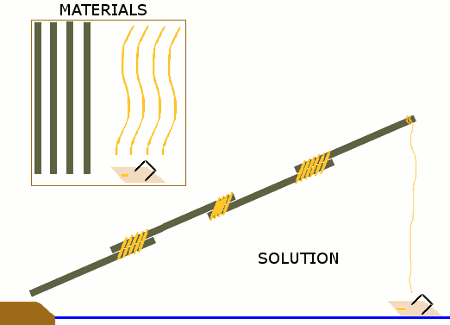 |
Find more Scouting Resources at BoyScoutTrail.com
Fist Ball | |
| Intended for: | Scouts BSA, Webelos Scouts |
| Required: | tennis ball |
| Instructions: | To start, define the play field and then everyone gathers in a circle shoulder to shoulder facing inward with one scout in the center holding the tennis ball. The scouts making the circle can not move their feet. The scout in the center closes both eyes, starts spinning around and lets loose the ball. Whoever is hit by the ball is IT and the game immediately begins. Now, everyone can run anywhere within the play field. IT hits another scout with the ball to make them an IT also. The last scout to be hit is the champion and starts the next game. The ITs can work together, throwing the ball around to get a good shot at someone. Those that are not IT can do two special things:
It can be a challenge to determine who is IT or not. One way to make it easier is to implement the rule that anyone not IT needs to keep their hands as fists at all times. For larger groups, two balls can be used. |
Find more Scouting Resources at BoyScoutTrail.com
Fitness Relay | |
| Intended for: | All Scouts |
| Required: | For each team, a paper bag containing cards with one task on each card. |
| Preparation: | Draw start line and put cone out about 20-40 feet. Place paper bag with cards at start line. |
| Notes: | Fitness, teamwork |
| Instructions: | Patrols line up single file. On 'Go' signal, patrol leader picks card from bag, reads it and does that task out around the cone and back to tag the next scout. A scout can not choose a card until tagged. First patrol to get through all tasks wins. May demonstrate each of the tasks first so scouts know what they are. Example Tasks: Hop on left foot, Hop on right foot, Hop with both feet together, Walk backwards, Walk heel-to-toe, Walk blindfolded, Run, Bear walk, Carry a person or have a person carry you, Hold hands between knees, and so on. |
Find more Scouting Resources at BoyScoutTrail.com
Flip the Penny | |
| Intended for: | All Scouts |
| Required: | a penny a tennis ball or small rubber ball |
| Instructions: | Place penny on the ground. Two scouts face each other, each about 3 or 4 feet from the penny. Scouts take turns throwing ball at the penny. Each hit on the penny is worth 1 point. Flipping the penny from heads to tails or tails to heads is worth 3 points. First scout to 15 or whatever score you choose is the winner. |
Find more Scouting Resources at BoyScoutTrail.com
Football Scramble | |
| Intended for: | All Scouts |
| Required: | a football, soccer ball, or nerf ball |
| Instructions: | This is a fast, active game with the direction of play changing constantly. Two teams on a football field or similar area. Play starts with a kick-off. Play resumes with a kick-off after a score. A team advances the ball to the opponent's end zone by throwing or kicking the ball. Rules:
A dropped pass in the field does not mean the other team takes control. Whoever picks up the ball is on offense. A scout could dribble the ball down the field by kicking it or tossing it in the air to themself. You might want to add a rule that no one can touch the ball twice in succession. |
Find more Scouting Resources at BoyScoutTrail.com
Four Kings | |
| Intended for: | Scouts BSA |
| Required: | paper and pencil |
| Instructions: | Divide the group of at least 12 people into two teams by combining patrols, or by gender if co-ed, or by red vs. black cards in a deck. Players need to remember who is on their team. Place four chairs in a row or mark four positions on the ground. These are the thrones where the Four Kings will sit. Write the name of each scout on a separate slip of paper and place them all in a bag, hat, or bucket. Randomly choose names from the hat, one at a time, to decide who will start sitting on the thrones. There must be two from each team. Everyone else makes a circle on the ground, including the four thrones as part of the circle, plus one empty spot someplace in the circle. Mix up all the slips of paper with names and pass it around the circle, everyone choosing one slip and showing no one. The scout to the right of the empty spot in the circle calls out someone's name. Whoever has that name on the slip of paper moves to the vacant spot in the circle and exchanges slips with the scout to their right (the person that called out the name). Now, the player to the right of the open spot (where the last scout moved from) calls out a name. The scout with that name on the paper moves to the vacant spot, exchanges slips, and the process continues. As soon as all four thrones are occupied by members of the same team, that team wins the round and the paper slips are reshuffled and passed out again for another round. |
Find more Scouting Resources at BoyScoutTrail.com
Fox and Hounds | |
| Intended for: | Scouts BSA |
| Required: | whistle for each fox. watch for each fox. |
| Preparation: | Select one volunteer fox for each patrol. Give each fox a whistle and tell each fox to make up a unique whistle signal. Foxes should synchronize watches. |
| Notes: | This is more fun after dusk when it is darker and more difficult to see running foxes. |
| Instructions: | Line up the foxes and have all the patrols gather. Tell each patrol which fox they will be chasing and have that fox blow their special signal so the patrol knows what to listen for. Once all foxes are assigned to patrols, give the foxes 3 minutes to disperse into the surrounding countryside, within easy hearing range of the leader's whistle. The leader should blow a whistle every 30 seconds so the foxes know they have not gone too far. When the leader gives the signal to begin (a very long blast on the whistle) then each fox gives their signal. From then on, each fox should give their signal about every 30-45 seconds so the hounds can track it. Foxes can walk, run, or crawl from place to place as they please. Patrols listen for their fox's signal and then take off tracking. Patrols must remain together as a single group. When a fox is caught, the fox should make note of the time and return to camp with the hounds. When all have returned, compare times to find the winning patrol. |
Find more Scouting Resources at BoyScoutTrail.com
Fox Hunt | |
| Intended for: | Scouts BSA |
| Instructions: | This is a great activity after a fresh snow. A large open area (such as a camp) is needed. Everyone must have a buddy for the game. A pair of scouts volunteer to be the foxes. They must remain together throughout the game. The foxes run off together from the starting location. Four or five minutes later, the leader releases the hounds (all the other scouts). The hounds track the foxes and try to catch them before the leader's whistle signals the end of the game. This should be about 30-40 minutes. A few 'rules':
The hounds win if they catch both foxes by tagging them. The foxes win if they get back to the starting location within 10 minutes after the whistle, but not before the whistle. For more than a dozen scouts, have more pairs of foxes and split the hounds. It is two or more separate games taking place at once. |
Find more Scouting Resources at BoyScoutTrail.com
Free For All Soccer | |
| Intended for: | All Scouts |
| Required: | A soccer ball and anything that can be used to determine goals, such as trees, water bottles, orange cones, etc. |
| Preparation: | Set the ball in the center of the play area and put the goal markers in their spots. |
| Instructions: | Everyone stands at least 10 feet away from the ball in the center of the play area. On "GO", everyone plays soccer, except that each scout is the only person on their team. There is no one to pass to, so each scout tries to control the ball and score a goal individually. To score, a player kicks the ball through any goal except their own. When the ball goes out of bounds, the scout whose own goal is closest to the ball retrieves it and kicks it into play from their own goal. While this goal kick is being made, everyone must stand 10 feet or more from the ball. If a goal is made, the kicker again kicks it from their goal. The first scout to score a set number of goals is the winner. You may have teams of two or three scouts if there are more than about 10 scouts. You could have patrols against each other for an troop game. |
Find more Scouting Resources at BoyScoutTrail.com
Frisbee Golf | |
| Intended for: | Scouts BSA, Bear Scouts, Webelos Scouts |
| Required: | Flying disc for each scout |
| Instructions: | Lay out a course with Tees and marked Holes. Or, take turns having each scout locate a distant object and say it is the target. Play the course together as a patrol. Scouts take turns throwing their discs towards the target, keeping track of the number of throws. Scout with fewest throws to hit the target wins the hole. |
Find more Scouting Resources at BoyScoutTrail.com
Frog or Kangaroo Relay | |
| Intended for: | All Scouts |
| Instructions: | From a starting line, the first scout on a team does a standing long jump with feet together, as far as possible. The next scout on the team does a jump starting with toes at the first scout's shortest mark, whether it be from hand, foot, or rear. The winning team is the one that has a longest total jump distance. Taller scouts and teams with more scouts are favored, but a few older scouts against many younger scouts may even out. |
Find more Scouting Resources at BoyScoutTrail.com
Fuzz Stick Relay | |
| Intended for: | Scouts BSA |
| Required: | pocketknife and 9inch dry stick of softwood |
| Preparation: | Define starting line and place knife and stick for each patrol out about 40 feet. |
| Notes: | Emphasize knife safety before the race. |
| Instructions: | On go signal, first scout runs to cutting area, opens knife, and cuts one sliver on the fuzz stick, closes the knife, and runs back to tag the next scout. Each scout repeats until there are 12 or 20 slivers on the stick. |
Find more Scouting Resources at BoyScoutTrail.com
Giants, Elfs, and Wizards | |
| Intended for: | All Scouts |
| Preparation: | Set up a playing area with safe zones marked at each end, about 60 feet apart. |
| Notes: | This is a team version of Rock, Paper, Scissors. |
| Instructions: | Teach everyone the following three characters:
Give scouts practice by calling out the characters and having them do the actions. Split the group into two teams. Each team huddles to decide on character. Teams line up facing each other at midfield with about 5 feet between teams. On signal, each team strikes pose for their character. Whichever team 'wins' chases the other team back to their safe zone. Those that are tagged join the chasing team.
Each team huddles to determine new character and repeat until all scouts are on the same team. |
Find more Scouting Resources at BoyScoutTrail.com
Gooey Gobble | |
| Intended for: | All Scouts |
| Required: | 2 or 3 large marshmallows per scout. a long string or fishing line per patrol. |
| Preparation: | Optionally, freeze the marshmallows to make them firm. Poke a hole through each marshmallow with a skewer and string it onto the line. Put the same number on each line - 16 or 24 for an 8-person patrol. Tie the string between two trees at about chest height. |
| Instructions: | Patrols line up at a starting line about 10 feet or so from the strings of marshmallows. On 'Go' signal, first scout in each patrol runs to their string, eats one marshmallow with hands clasped behind back, then tags next in line. Repeat for a set time length or until one patrol has eaten all their marshmallows. Each eaten marshmallow is worth 5 points. Any touching marshmallows with hands takes away 3 points. Any dropped pieces on the ground take away 3 points, unless they are eaten. |
Find more Scouting Resources at BoyScoutTrail.com
Grab Five | |
| Intended for: | All Scouts |
| Required: | 5 stones, coins, or buttons. Up to 18 scouts. If you have more than 18 players, set up separate games. |
| Instructions: | Draw a 6 inch circle on the ground or place a paper plate on the floor. In this circle, place 5 stones. About 20 feet away make another circle or plate. 20 feet the other direction, make another circle or plate so there are 3 circles in a row. Divide into two even-numbered teams. Teams sit on the ground in parallel lines, one team on each side of the row of circles. The leader numbers off everyone in one team then in the other team, in the opposite direction. To play, the leader calls out a number. Those numbered scouts from each team run to the center circle and each grab a stone. They run to their own team's end circle and place the stone there. They run back for the second stone and place it in their end circle. The first scout to get back to the center circle and grab the last stone wins the round. First team to some specified number wins. |
Find more Scouting Resources at BoyScoutTrail.com
Greased Watermelon | |
| Intended for: | Scouts BSA |
| Location: | This Game should be held in water.It requires a medium sized space. |
| Required: | watermelon shortening |
| Preparation: | coat the watermelon with shortening to make it slippery. Define the play area in the water with a center line and two endzone goal lines. Water should be between waist and chest deep. |
| Notes: | Follow safe swim practices. |
| Instructions: | Divide into two teams, each lining up on their goal line. Float the watermelon at the center line. Object is to acquire watermelon and move it across the opposing goal line. The watermelon can not be lifted out of the water. Safety: Lifeguards need to pay very close attention to the scrimmages and keep a sharp eye out. |
Find more Scouting Resources at BoyScoutTrail.com
Group Push | |
| Intended for: | Scouts BSA |
| Preparation: | Mark out large squares on the ground or floor with chalk, rope, or tape - as many as you have patrols. The squares should be large enough for the entire troop to stand inside comfortably. The squares should be in a long line with sides touching. |
| Notes: | Remind larger scouts of potential injury and be prepared to blow a whistle to stop the game when needed. |
| Instructions: | The goal is to have the lowest average score, similar to golf. Each square has a point value starting at 1 up to the number of squares. All scouts start in square #1. On the 'GO' signal, scouts try to push other scouts into the next square in line, #2 then #3 then #4 ... When any part of a scout touches inside the next square, that scout is out and must go to that square. Scouts pushed out the sides of a square return into that square at the exact spot they were pushed out. The game ends when there is no one left to push or a time limit is called. A team's score is calculated by adding up the value of the square in which each scout is left standing and dividing that by the number of people in the patrol. This game gives a tremendous advantage to larger, stronger scouts - but groups of scouts can work together. After playing once, it might be good to reflect and see if the troop wants to try it again. |
Find more Scouting Resources at BoyScoutTrail.com
Guardian | |
| Intended for: | All Scouts |
| Required: | 6 to 15 scouts. tennis balls or Nerf football or other kind of balls. 5 or 6 plastic soda bottles. |
| Instructions: | One scout is the 'Guardian' with the job of protecting the pillars of energy from incoming meteors. Draw a circle about 20 to 30 feet in diameter and have all scouts outside the circle. The Guardian stands in the center of the circle and sets up the pillars in a circle around the Guardian. Give one scout a ball. Scouts try to throw the ball and knock down a pillar. The Guardian protects the pillars by catching the ball or knocking it away. Whoever knocks down a pillar gets a point per pillar. The Guardian gets a point for every pillar left standing after 2 minutes (adjust the time as needed). When the Guardian stops the ball, the Guardian rolls it back out to the circle of players immediately. Players can not come inside the circle. Using a Nerf ball or tennis ball is safer. If the Guardian seems to be having a very easy time, use 2 balls. |
Find more Scouting Resources at BoyScoutTrail.com
High Adventure Race | |
| Intended for: | Scouts BSA |
| Preparation: | Need a judge for each patrol. |
| Instructions: | Scouts are going on a high adventure outing. They need to backpack, set up a tent, portage a canoe, lash a camp gadget - all using just scouts. Backpack: Each of one half the team carries one other team member like a backpack for a set distance. Points for speed and secure pack. Tent: Team splits in half and forms two parallel lines facing each other. They lean in towards a partner, supporting each other with their hands to form a tent-like 'A' structure. Points for the distance between partners, for style, for speed. Portage: One scout lays down perfectly straight and rigid. All the rest hoist this scout unto their shoulders and carry the scout a set distance. Points for speed, safety, canoe rigidity. Lashing: Team needs to build a camp gadget using all team members. Points for creativity and implementation. |
Find more Scouting Resources at BoyScoutTrail.com
Hit the Bucket | |
| Intended for: | All Scouts |
| Required: | tin bucket to stand on. 18 inch long dowel or stick. tennis ball or small rubber ball. |
| Notes: | This game is fun to play during free time and does not need to have scoring. |
| Instructions: | Turn the bucket upside down and one scout stands on the bucket while holding the dowel as a bat. All other scouts try to hit the bucket with the ball while the scout on top tries to deflect the ball with the stick. If a scout hits the bucket, then that scout gets to be on top. If the scout on top falls off, then the scout that last threw the ball gets to be on top. The ball must be thrown from the spot where it is picked up after the last throw and/or deflection. |
Find more Scouting Resources at BoyScoutTrail.com
Hoop on a Loop | |
| Intended for: | All Scouts |
| Required: | hula hoop or 8 foot length of rope tied in a circle for each patrol |
| Notes: | You may even up the number of scouts in each patrol to make the game fair. |
| Instructions: | Each patrol stands in a circle, facing inward. The hoop is hung on one scout's arm. Each scout in a patrol holds hands with neighbors so the circle is complete and the hoop is hanging. On 'GO', each patrol moves the hoop around their circle from scout to scout without letting go of hands. First patrol to finish 2 or 3 laps wins. |
Find more Scouting Resources at BoyScoutTrail.com
Human Compass | |
| Intended for: | Scouts BSA |
| Instructions: | All scouts spread out with arms length between scouts. Choose one wall of the room to be 'North'. Each scout is a compass. The leader calls out a direction, such as 'South', 'NorthWest', ... and all compasses face that direction before the leader calls out 'Freeze'. All scouts facing the wrong way sit down. Continue until there is only one scout left. Optional:
|
Find more Scouting Resources at BoyScoutTrail.com
Human Foosball | |
| Intended for: | All Scouts |
| Required: | balloons |
| Instructions: | Divide the group in half. Sit the scouts down in a pattern as below, placing them very close together. Make the pattern as large as needed for group. + - - - - + | X O X O | | O X O X | | X O X O | | O X O X | | X O X O | | O X O X | | X O X O | + - - - - + The 'X's try to move the balloon to the 'O's endzone by batting it in the air. The 'O's try to move it the other direction. 2 points are scored if the balloon hits the floor past the end zone. 1 point is scored if a scout on opposing team catches or grabs the balloon - only hitting is allowed. Players must remain seated. |
Find more Scouting Resources at BoyScoutTrail.com
Human Ladder Race | |
| Intended for: | All Scouts |
| Preparation: | Place two lines, poles, or markers of some kind about 30 feet apart. Place two ribbons or flags on one of the markers. |
| Instructions: | Line up two patrols facing each other with patrol leaders at the head of the line facing each other. Each scout should be shoulder to shoulder with their teammates. Have all scouts sit down with legs extended together straight forward so their feet touch the feet of the scout from the other patrol across from them. Arrange the people so the feet are lined up all the way down the line, like this: + F F + | | | | | O== ==O | | O== ==O | | O== ==O | | O== ==O | | O== ==O | | O== ==O | | | | | + x x + In the diagram, the 'F' is the flag. The 'x' is the 2nd marker. The patrol leader is the scout at the top of each column of sitting scouts. On signal, each patrol leader jumps up and runs to the patrol's flag, grabs it, runs down to the 2nd marker, stepping over the legs of their patrol. When they touch the 2nd marker, they run back to their starting place and sit down. They then hand the flag to the next scout in line who runs the same course. In this way, the first scout that a running scout steps over is the scout that just ran - this should help eliminate false starts. The last scout to run places the flag on the 2nd marker and the first patrol to do that is the winner. Alternate Layout: You can place obstacles such as tires, chairs, benches, knots to tie, questions to answer, ... outside the lines of scouts. Instead of having each scout run over the legs twice, you could have them run one length of the course behind their team forcing them to accomplish the obstacles. |
Find more Scouting Resources at BoyScoutTrail.com
Hunker Down | |
| Intended for: | All Scouts |
| Required: | 2 low pedestals about 1 foot square (a piece of plywood set on 2 bricks works) 15 foot rope |
| Preparation: | Place pedestals 6-8 feet apart |
| Instructions: | One scout stands on each pedestal, holding an end of the rope. On the leader's signal, each scout tries to cause the other to step off their pedestal or let go of the rope, by pulling or pushing the rope. Instead of a rope and pedestals, two scouts can stand on a plank laid across the two pedestals. Then, they try to get the other to step off by:
|
Find more Scouting Resources at BoyScoutTrail.com
I Am Mr. Smith | |
| Intended for: | Scouts BSA |
| Required: | paper and pencil per scout 4 or 5 adult leaders chalkboard or flipchart |
| Instructions: | All scouts are given paper and pencil. The 5 adult leaders stand at the back of the room. All scouts sit down facing the front of the room - they may not glance to the back of the room during the game. The game leader stands at the front of the room. The game leader writes "Mr. Smith" or "Mrs. Jones" or the name of any of the adult leaders on the board. Each scout writes that name on their paper. The game leader points to the first adult leader, saying "Number 1?". He replies, "I am Mr. Smith" in a disquised voice. The game leader points to the next and says, "Number 2?" and he replies. And so on for all adults. Scouts write down the number of the adult they believe is the real Mr. Smith. Erase the name on the board and repeat for each of the adult leader names. Each correct Name - number match is worth 1 point. Tally the total points in a patrol and divide by number of patrol members. Patrol with the highest average points wins. |
Find more Scouting Resources at BoyScoutTrail.com
I'm Taking | |
| Intended for: | All Scouts |
| Notes: | This is a 'figure it out' game. |
| Instructions: | One scout starts by thinking up a relationship between two things. For example, things that start with 'C'. Leader says, "Im going Camping and Im taking a Carrot and some Cereal." As the leader makes more statements, the others try to figure out the relationship. When someone thinks they know, they can make a statement and the leader can say if it is correct or not. Continue with statements that follow the rule until everyone gets the relationship. Once scouts in your group are familiar with the game, more difficult relationships or rules can be used...
|
Find more Scouting Resources at BoyScoutTrail.com
Infinite Dodgeball | |
| Intended for: | All Scouts |
| Required: | soft ball (rubber or foam) |
| Preparation: | mark off play area or use entire room |
| Notes: | No one is ever out. You can keep playing an infinitely long time. |
| Instructions: | All scouts find a spot to stand in the play area. They must remain in that spot. One scout is chosen as IT. Everyone tries to hit IT with the ball while IT runs around trying to avoid the ball. When someone hits IT, that scout immediately becomes IT and runs away. Scouts can only move from their spot to retrieve a ball to which they are closest. Leaders may call a timeout for repositioning occasionally. |
Find more Scouting Resources at BoyScoutTrail.com
John Henry Relay | |
| Intended for: | All Scouts |
| Required: | mallet and 4 tent pegs for each team |
| Instructions: | Define starting line where each patrol lines up to start. About 30 feet away from start line, place a mallet and tent pegs for each patrol. Space the gear for each patrol far from each other for safety. On 'GO', first scout on each patrol runs to the patrol's gear, grabs the mallet, positions a peg, takes one swing, and lays the mallet down. That scout then runs back to tag the next scout in line who gets one swing. First patrol to drive all pegs into the ground, wins. May need judges to determine that a peg is finished. Could use hammers and nails into a piece of 2x4 lumber indoors. |
Find more Scouting Resources at BoyScoutTrail.com
Jump the Shot | |
| Intended for: | Scouts BSA, Webelos Scouts |
| Required: | rope - 10 feet beanbag or other soft weight, tied to end of rope. |
| Notes: | Some reflection about how the scouts that got hit were treated by their own teammates and the other scouts might be useful. |
| Instructions: | Each patrol starts with 30 or 50 points. Scouts form a circle about 18 feet in diameter. Leader stands in the center with the rope. Leader starts swinging the rope around at ground level and increases the length of the rope until it is out to the scouts. People must jump over the rope as it swings by. A scout hit by the rope loses 5 points for his patrol. When a patrol's score reaches 0, all members of that patrol drop out of the circle. The last patrol left wins. Keep the rope between ground and knee level. Have an alternate rope swinger ready in case one gets dizzy. Alernative: When a scout is hit, that scout drops out of the circle. Last one left wins. |
Find more Scouting Resources at BoyScoutTrail.com
Kangaroo Tails | |
| Intended for: | All Scouts |
| Required: | about 1 meter of string or rope for each scout |
| Instructions: | Set boundaries for the area you want to play in and make sure everyone knows the boundaries. Each scout puts one end of the string into a back belt loop. The tail should be long enough that at least 4 inches of it touches the ground. When play starts, everyone tries to stomp on other players' tails. You can not use your hands. If a scout happens to fall, that scout has ten seconds to get up before other players can stomp their tail. Once your tail is out, you are out. The last player with a tail is the winner. |
Find more Scouting Resources at BoyScoutTrail.com
Kangaroo Wrestling | |
| Intended for: | Scouts BSA, Bear Scouts, Webelos Scouts |
| Preparation: | Mark off a 8 or 10 foot diameter circle |
| Notes: | This can be fairly rough, but there's not much risk of injury. |
| Instructions: | Leader numbers off scouts. All scouts stand around the circle in any order. Leader calls out two numbers and those two scouts enter the ring to wrestle. Before entering the ring, each kangaroo must cross his arms over his chest and hop on one foot. A kangaroo loses if:
Wrestling is done by bouncing into each other - no grabbing with hands. |
Find more Scouting Resources at BoyScoutTrail.com
Keys In a Can | |
| Intended for: | All Scouts |
| Required: | A chair a metal bowl keys(preferably a lot of keys. If you can't find keys use something else noisy.) a blindfold |
| Preparation: | Put the chair in the middle of a room with the bowl of keys under it. Have a scout blindfolded sit on the chair - this is the Guard. |
| Notes: | Have the scouts stand or sit around the guard about 8 feet away |
| Instructions: | The leader says, "A Thief is Coming." This lets the Guard know to be on alert. The leader points to one scout in the circle, indicating that scout is to try and retrieve the keys. If the Guard hears the thief approaching, the Guard points at the thief. If the Guard points right at the thief, the thief becomes the Guard. The leader can appoint more than one thief at a time if desired. |
Find more Scouting Resources at BoyScoutTrail.com
Kim's Game | |
| Intended for: | All Scouts |
| Required: | Paper pencil for each scout. Various items of interest. |
| Notes: | This is a traditional observation game. |
| Instructions: | Collect a number of items and place them under a tarp or sheet. Have the scouts gather around and uncover the items for 1 minute. Cover the items and have each scout write down every item they can remember. The one with the most correct items has demonstrated the best observation and recollection skills. Alterations:
|
Find more Scouting Resources at BoyScoutTrail.com
Kim's Group Game | |
| Intended for: | Scouts BSA, Wolf Scouts, Bear Scouts, Webelos Scouts |
| Required: | Large piece of cardboard with 9, 16, or 25 squares depending on skill level of scouts. Various items to place on the cardboard - red feather, black feather, gray stone, white stone, neckerchief, pocketknife, pinecone, sunscreen, ... |
| Preparation: | Place all the items on the board, one in each square. Do this away from the group so they do not get to study it. Write down what is where. |
| Instructions: | Scouts silently gather around the board and observe the items on it and their placement for 30 seconds. All items are swept off into a pile. The timer is set as the scouts walk around the board in a circle, each taking a turn to put an item in position. On a turn, a scout may choose to move an item from one square to another if the scout feels it is incorrect. When all items are in place, and the team signals that they are finished, 1 point is awarded for each correct item and the time is recorded. Allow the team to discuss a plan for 30 seconds away from the game while the items are arranged again. See if a better score can be made in a shorter time. |
Find more Scouting Resources at BoyScoutTrail.com
King Bat | |
| Intended for: | All Scouts |
| Required: | blindfolds |
| Instructions: | All the bats in a colony try to return home to their own cave where their King Bat is calling them. All scouts gather at one end of the play area and put on blindfolds. Patrol leaders spread out at the other end of the play area and put on blindfolds. On "GO" signal, all scouts race to their patrol leader. The first patrol to have all scouts touching their patrol leader is the winner. Safety: Since everyone is blindfolded, there needs to be a few referees with whistles. Whenever a whistle sounds, everyone must stop immediately until a double-blast whistle sounds to resume play. Referees need to redirect wandering players away from danger. You can also expect a lot of collisions so playing this on grass is best. After completing one round, give patrols a few minutes to strategize and then do a new round. Possible strategies might include a more easily heard and understood signal, a special handshake to identify teammates, ways to determine if everyone is present, methods to confuse other patrols. |
Find more Scouting Resources at BoyScoutTrail.com
Kubb | |
| Intended for: | All Scouts |
| Required: | a Kubb set or, 16 feet of branches and a saw |
| Instructions: | A very simple outdoor game that can be played anywhere with the goal of throwing sticks to knock over blocks. Kubb is played between two teams of 1 to 6 people. The gamefield looks like: 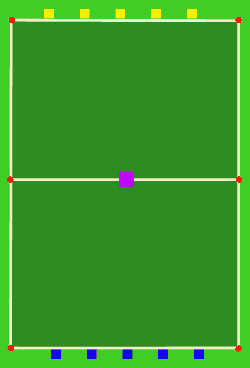 where the red circles are six stakes marking the end and center lines, the purple square is the King, the yellow squares are one team's base kubbs, and the blue squares are the other team's. One team throws six wooden batons at their opponent's base kubbs. Then, all knocked over kubbs are tossed by the defender to the attacker's side of the field. There, they are set upright and called 'field kubbs'. The second team is now the attacker and tries to knock down all the opponent's field kubbs first, then their base kubbs. This continues until one team has knocked down all their opponents kubbs. That team then tries to knock down the King to win the game. 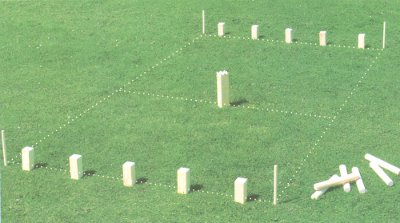 There are National and World Kub tournaments and it continues to grow in popularity. You can read the USA Rules or World Rules. To make your own kubb set, you need:
See How To Steps. There's no reason you can't just gather and cut some sticks and branches and play this game in the wild. There are also many rule variations which help to shorten the games or make play more even between pros and newbs. |
Find more Scouting Resources at BoyScoutTrail.com
La Palma | |
| Intended for: | All Scouts |
| Required: | 2foot stake 5 or 6 short pegs 4 or 5 tennis balls |
| Instructions: | 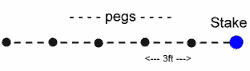 Stick the stake in the ground. Measure 3 feet from the stake and stick a peg in the ground. Place another peg every 3 feet in a line out from the stake. Starting at the closest peg, the first scout throws a ball at the stake. If the stake is hit, the scout moves on to the next farther peg for the next turn. If the scout misses, they stay at the current peg for their next turn. After throwing a ball, that scout retrieves the ball and gives it to the next scout waiting to throw. With a few balls, there should be very little waiting. The first person to progress all the way to the last peg and hit the stake from there wins the round. Play as many rounds as the scouts want or until it's dinner time. |
Find more Scouting Resources at BoyScoutTrail.com
Last Match | |
| Intended for: | All Scouts |
| Required: | box of wooden matches |
| Notes: | Good gathering time game as more can join after each round if you use the alternative method. |
| Instructions: | Scouts gather around. Lay out any number of matches in any number of piles, as long as there are at least 2 matches in 2 piles. Each scout takes a turn removing any number of matches from one pile. The scout that is forced to remove the last match is out. Repeat until there is one scout left. Alternative: The scout that removes the last match is the winner of 1 point. |
Find more Scouting Resources at BoyScoutTrail.com
Leg Pull | |
| Intended for: | Scouts BSA |
| Preparation: | Draw parallel lines about 10 feet apart and 30 feet long. |
| Notes: | It works better to have team members line up by increasing size so opponents are more nearly matched. |
| Instructions: | Line up even number of scouts from each patrol facing each other between the parallel lines. Have the scouts close enough that they can almost put their hand on their opponent's shoulder. Each scout lifts their left leg straight out forward and grabs the left leg of their opponent with their right hand. On 'Go' signal, each scout tries to hop backwards and pull their opponent with them over the goal line behind. To make it more of a group tussle, have each scout hold the legs on both their right and left sides. This should create a long, connected team of one-legged scouts all pulling against the other patrol. |
Find more Scouting Resources at BoyScoutTrail.com
Line Up | |
| Intended for: | All Scouts |
| Notes: | Some fast 'get to know you' activity that gets scouts to recognize things about others. |
| Instructions: | Have the group line up in different ways.
|
Find more Scouting Resources at BoyScoutTrail.com
Liquid Chain | |
| Intended for: | All Scouts |
| Required: | 1 small paper cup per scout. 1 larger paper cup per scout. 2 cans or small buckets per team. water. |
| Preparation: | Place one can full of water at the starting point for each team - each with the exact same amount of water. Place an empty can for each team far away from the start. Divide the distance between the start and end into a section for each scout on the team |
| Instructions: | Tell each team to choose a play area and have one scout from each team stand in a section. Give a paper cup to each scout. People can not leave their sections. On 'Go' signal, first scout fills their cup and transfers the liquid to the next in line. Repeat all the way to the last scout who fills the bucket. Team that fills the end bucket to a predefined amount first wins. OR, team that has transferred the most water in a set time wins. OR, when each starting bucket is empty, team with the most water in their end bucket wins. Alternate: Use larger and smaller paper cups, giving at least the two closest to the starting point a larger cup and those at the end smaller cups. Let teams try a second time rearranging their team if they want. Alternate: Blindfold every other scout so they must listen to teammates to find where to pick up and drop off water. |
Find more Scouting Resources at BoyScoutTrail.com
Log Sawing Relay | |
| Intended for: | Scouts BSA |
| Required: | 3" or 4" diameter log for each patrol. Handsaw for each patrol. |
| Notes: | Determine number of scouts in largest patrol and each patrol needs to cut that many discs. |
| Instructions: | Logs are placed about 20 feet from each patrol on secure cutting surface with handsaw next to it. On signal, patrol leader runs to log, saws off a disc and brings it back to the start line to tag next scout. Repeat with each scout until the correct number of discs have been retrieved. First patrol to give yell and sit down wins. |
Find more Scouting Resources at BoyScoutTrail.com
Long, Short, Round Relay | |
| Intended for: | All Scouts |
| Required: | for each team: - two tin cans - one stick - one ping pong ball - one rock |
| Instructions: | Place one can from each team in a circle. Place the stick, ball, and rock for each team in their can. Place the other can for each team about 30 feet out from the circle. Have members of a team sit in a line facing the inner circle between their inner can and outer can. Give each team member a number, from #1 in the center to the last number for the last member. The game leader stands in the center of the circle. He makes a sign for Long, Short, or Round and calls out a number. The scout on each team whose number he calls races to the can, retrieves the appropriate item, takes it to the other can, then returns to the starting position. The first one back to the starting spot earns one point for the team. As the game progresses, everyone needs to remember in which can the long, short, and round items are so they run to the correct can to retrieve it. If you don't have enough space, the relay lines can be in parallel instead of a circle, but this layout lets everyone see all the other teams and the game leader more easily. The game leader can have whatever signs he wants for long, short, and round and you could even use any three distinct items or even more items. |
Find more Scouting Resources at BoyScoutTrail.com
Make It Up Relay | |
| Intended for: | Scouts BSA |
| Required: | paper and pencil for each patrol a judge for each patrol a cone or marker for each patrol |
| Preparation: | Define a starting line and turn-around spot about 30 or 40 feet away for each patrol. |
| Instructions: | Patrols are given 2 minutes to write down the name of each member in the order that they will run the race. Also write the method of running that scout will do. For example, Pat - hop on left foot Taylor - hop on right foot Eddie - run backwards Sam - run normal Smaller patrols need to write down names multiple times so they have the same number of races as the largest patrol. They must memorize their list and then hand it in to the judge for their patrol. All patrols line up on the starting line. On go signal, the first member on list runs their race, followed by next, to the last scout. The judge checks that the correct scout runs the correct type of race in the correct order. You might have a list of ways to run and each team needs to just match a scout with each style. This would ensure each team runs the same races. |
Find more Scouting Resources at BoyScoutTrail.com
Making Change Relay | |
| Intended for: | All Scouts |
| Required: | For each patrol: 4 pennies, 1 nickel, 2 dimes, 1 quarter, 2 small boxes or chairs or squares of paper |
| Instructions: | For each patrol, place a box at one end of the play area - this is the patrol's Bank. At the other end of the area, a second box is the Store. A couple judges are needed by the Stores - they are the store clerks. The idea is to take the required coins from the Bank to make exact change at the Store. Patrols line up in the center of the area, halfway between their Bank and Store. One scout from each patrol gets ready to race. The leader calls our a price from 1 cent to 53 cents. This is the amount that the Store clerk requires. The scout moves coins from the Bank box to the Store box so there is that exact amount at the Store, then returns to their patrol. First scout home with the correct amount at the Store gains a point for their patrol. |
Find more Scouting Resources at BoyScoutTrail.com
Manhunt | |
| Intended for: | All Scouts |
| Notes: | This game is best played at night in a large outdoor area. |
| Instructions: | (just the opposite of Sardine Tag) 2, 4, or 6 scouts are 'IT', depending on size of the group. Everyone else has 2 minutes to go and hide in the play area. The ITs head out as a group, or in pairs, to find hiding scouts. When found, a scout becomes IT too and helps find others. The last scout found is IT for the next round. |
Find more Scouting Resources at BoyScoutTrail.com
Math Masters | |
| Intended for: | All Scouts |
| Instructions: | Within each patrol, have scouts pair up. If there is an odd number, the patrol leader gets a 'Bye'. Scouts face each other. Each scout puts both hands behind their back and holds out 0 to 10 fingers. The leader explains what the math problem for this round will be and then yells, "Ready - Go!" and everyone holds their hands together in front. The first scout in a pair to say the correct answer wins the round and advances to the next round. When there is a champion of each patrol, they compete for the troop championship. Rounds can be any math problem you want, depending on the age of scouts, but try these:
|
Find more Scouting Resources at BoyScoutTrail.com
Memory Battleship | |
| Intended for: | All Scouts |
| Required: | For each patrol:
|
| Instructions: | This can be played by 2, 3, or 4 patrols. More than that and there is too much waiting time. Each patrol is given a Base in a corner of the play area. On the floor or ground, mark a 7x7 grid using chalk or the twine. Each square should be about 6 inches. Across the top, the squares are numbered 1 to 7. Down the side, the squares are lettered A to G. This is their Battleship grid. (a premade grid on a sheet of paper or cardboard would be easier and reusable) So other patrols can not see, set up a cardtable in front of each grid, or protect it with a cardboard box, or any barrier. Each patrol places their 10 items on their grid. These items could be related to First Aid, or Cooking, or Nature, or whatever theme you wish. For example, a bandaid, tweezer, magnifying glass, splint, alcohol wipe, q-tip, water bottle, flashlight, moleskin, and scissor. On 'GO', each patrol goes and views every other patrol's grid, trying to memorize the placement of each item. No writing down of information is allowed. After 1 minute, all scouts return to their patrol's Base. Taking turns, each patrol tries to capture another patrol's items. Do this by declaring the patrol name, the grid square letter and number, and the item at that location. If correct, the shooting scouts are given the item to keep in their Captured pile. Continue until a patrol is eliminated by losing all its items or until every patrol misses its shot in a round. Once either of these happen, the remaining patrols are given 1 minute to observe their opponents grids again. Repeat this until only one patrol remains as the winner. The scouts should develop strategies over time, such as concentrating on one opponent or having each scout memorize just a couple items. Patrols with more members present have an advantage. Patrols may gang up on one patrol. |
Find more Scouting Resources at BoyScoutTrail.com
Monkey in the Middle | |
| Intended for: | All Scouts |
| Required: | 6 or more scouts a ball |
| Instructions: | Scouts form a circle from 12 to 30 feet in diameter depending on number of scouts. 'It' is inside the circle. Players pass a ball around the circle preventing 'It' from touching it. If 'It' touches it, the last scout to touch it is now 'It'. Variations: With a larger group, have 2 'Its' and make the circle larger. Have a 2nd circle outside the first one and players have to stay inside the ring to help keep players closer. |
Find more Scouting Resources at BoyScoutTrail.com
Monster Hunt | |
| Intended for: | Scouts BSA |
| Required: | A 3x5 card for each station - need at least one station for each patrol. A 3x5 card for each patrol. Materials for each monster as listed below. |
| Preparation: | On each patrol's card, print the patrol name and Find [MonsterX] with the name of one of your monsters. Give each monster his specific card. |
| Notes: | You can make the tasks as easy or complicated as needed. It is better to keep them approximately the same level of time to complete or have extras in case of a traffic jam at one monster. |
| Instructions: | Patrols are sent out to complete different tasks and find all the monsters. Once all the Monsters are ready, give each patrol leader their patrol's card. Each patrol should be started out looking for a different monster. When a monster is found, the patrol asks what monster he is. If he is the one they are looking for, then they must perform the task required by the monster. When completed, the monster marks their card and they go looking for the monster he reads off his card. The winning patrol is the one that completes the most tasks in a given time. On each monster's card, print one of these lines:
4 ropes and 2 poles for Frankenstein. 2 compasses for Wolfman. Godzilla - at least 3 ways to start a fire - flint/steel, steel wool and battery, magnesium. Dracula - two poles and a blanket. |
Find more Scouting Resources at BoyScoutTrail.com
Mouse Trap War | |
| Intended for: | All Scouts |
| Required: | 4 mouse traps per patrol a pile of newspapers |
| Instructions: | One team sets its 4 traps in a line and places its pile of newspaper behind the traps. The other patrol sets its traps in a line parallel to and about 15 or 20 feet from the first patrol. Half the scouts of patrol 1 sit at least 5 feet from their traps - their rears must stay on the ground. The other scouts stand behind their traps - they must stay behind the traps. On "GO", the standing scouts each grab one sheet of newspaper and wad it into a ball. They each throw their ball at the opposing patrol's traps, trying to spring one. The sitting scouts in the middle try to deflect the thrown balls. They can toss deflected balls back to their own side, but not towards the opposing side. The standing scouts can not interfere with thrown balls. The standing scouts can pick up and reuse papers. If a trap springs for any reason, it is sprung - no resets. The last patrol with an unsprung trap wins the round. You may have multiple wars going on in different, separated areas with the winners advancing to a championship round. Or, use a round-robin rotation with each patrol getting 1 point for each win. |
Find more Scouting Resources at BoyScoutTrail.com
Mousetrap Fishing | |
| Intended for: | Scouts BSA |
| Required: | many 5ft lengths of strong twine or rope (at least 3 per patrol) 3 5-6ft staffs or bamboo per patrol (broom handle size) 1 mousetrap per patrol various items to retrieve - neckerchief, plastic bottle, baseball cap, ... |
| Preparation: | Drill a hole or screw in a screw-eye to the 'safe' end of each mousetrap. |
| Instructions: | Mark the river bank, past which scouts may not step. Place the treasures about 12 feet out from the bank. Patrols can use as many lengths of twine as they need to lash their poles together to create a fishing pole, tie the mousetrap to the end, then use it to catch items and retrieve them. You may have the same set of items for each patrol to retrieve and the first done, wins. Or, different items may have different values that you can tell before the contest or after. |
Find more Scouting Resources at BoyScoutTrail.com
Mousetrap Minefield | |
| Intended for: | All Scouts |
| Required: | a couple dozen or more mousetraps. Other obstacles. |
| Notes: | Make sure scouts all have on shoes. The mousetraps do not hurt through shoes, but no need to tell the scouts that before the game. |
| Instructions: | Mark off a play area with a starting line about 30 feet from finish line. Make the area 15-20 feet wide, depending on the number of teams. Team leader is at finish line. First scout in patrol is blindfolded and stands at starting line with rest of patrol lined up behind. On signal, every patrol leader instructs their player through the minefield. If the blindfolded scout trips a trap or runs into another obstacle, that scout is out and the next scout in the patrol is up. The patrol with the most scouts through the minefield in a set amount of time wins. A more narrow play area makes collisions between players more common. Just use chairs as obstacles for a simpler game. For a massive, quick game, have scouts partner up. All the blindfolded scouts stand at one end and their partners are at the other. On 'GO', all seeing scouts try to guide their blind partner through the minefield to be the first to reach safety. It's loud and wild! |
Find more Scouting Resources at BoyScoutTrail.com
Mud Wallow | |
| Intended for: | Scouts BSA |
| Required: | kiddie swim pool small bucket for each patrol 50-100 coins mud |
| Preparation: | dump the coins in the kiddie pool. Fill the pool with mud. |
| Instructions: | Make sure there is a lake, river, or hose available to wash off after the event. Each patrol has a small bucket. Patrols gather 10-20 yards from the mud hole. On 'GO' signal, one scout from each patrol runs to the mud hole with a bucket and searches for one coin. When a coin is found, the scout raises the coin overhead and shouts "Eureka!" or some such exclamation and drops it in the bucket. The scout then runs back to the patrol and passes the bucket to the next scout. Continue the relay until a time limit is reached or it appears all coins have been found. The patrol with the most coins wins. A judge by the mud hole may be needed to ensure only one coin at a time is recovered. You could have a Trading Post where patrols could exchange what they collected for snacks or stuff. Depending on your budget, there's no reason you couldn't use jello, chocolate syrup, or baked beans in the kiddie pool. You could also collect something other than real coins - plastic coins, marbles, plastic soldiers, whatever - with different values for each item. |
Find more Scouting Resources at BoyScoutTrail.com
Mule Relay | |
| Intended for: | Scouts BSA |
| Required: | An identical set of items for each patrol. box or backpack, flashlight, sleeping bag, big rock, hat, whistle, pencil, ... anything at all ranging in different sizes and weights. Just make sure that a person will be able to carry the entire load. |
| Preparation: | Put all items for each patrol in separate piles on the ground about 40 feet from the start line. |
| Notes: | It may be beneficial to reflect on how choosing items intelligently may reduce the amount of work required and the ease with which items are transported. |
| Instructions: | Patrols line up at start line. On 'GO' signal, patrol leader runs to pile and chooses one item to bring back. The patrol leader also must choose the name of one item to tell to the next scout. When the patrol leader returns, he hands what he has to the next scout and tells that scout the name of the item to be picked up. Each scout runs to the pile, picks up the item they were told and adds it to their load. They then choose the name of another item to tell the next scout to pick up. This continues until a patrol returns with all their items to the starting line. If an item is dropped, the scout has to return to retrieve it. A returning scout should not talk to anyone except the next scout in line. |
Find more Scouting Resources at BoyScoutTrail.com
Natural Selection | |
| Intended for: | All Scouts |
| Required: | tarp, blanket, or jacket to cover items |
| Preparation: | Find a dozen natural items from around the area and spread them out on the ground. On a piece of paper, diagram the layout of the items for later scoring. Put a point value on each item. Cover them with the tarp. |
| Instructions: | Gather the teams around the tarp. Remove the tarp and give them one minute to study the items. Cover the items. Tell everyone that their job is to select similar natural items and bring them back to their team's area. They will have 10 minutes. The more identical to the original item, the more points are scored. For example, matching a grey rock with white spots is worth more than just any old rock. Finally, arranging the items in the same order as the originals under the tarp gains extra bonus points. You may allow players to re-examine the originals at a cost of 1 point per second per scout. So, if two scouts look for 8 seconds, that costs 16 points. Since the game leader determines values for items, you can make this a trivial or extravagant expense. Take care to only choose non-living items and remind teams to be gentle on the land. |
Find more Scouting Resources at BoyScoutTrail.com
Nature Boulles | |
| Intended for: | All Scouts |
| Required: | a target ball 2 balls per scout |
| Instructions: | Each scout finds two natural 'balls' which can be pretty much anything you can throw - rocks, pinecones, sticks, ..., whatever. Everyone needs to be able to identify their items in a pile of similar items. Maybe color them, scratch with a knife, or tie string on them. One scout throws the target ball (a rock, frisbee, pinecone, stick) out into the field. Players then take turns throwing their items at the target. The closest scout receives a point and gets to throw the target for the next round. Either pass time wandering around the area playing or keep points for determining the winner. |
Find more Scouting Resources at BoyScoutTrail.com
Naval Combat | |
| Intended for: | Scouts BSA |
| Required: | For each patrol:
|
| Notes: | You may prefer to combine patrols so you have 3 or 4 teams. |
| Instructions: | In a central area, mark off a circular area about 30 feet round - this is the battleground. Define a separate shipyard for each team about 20 feet outside the battleground. In this area, place all their strips of cloth and all 3x5 cards. Each player loosely ties a strip of cloth on their arm to identify their team. Then, each player that wants to do combat, chooses the type of ship they want to be and enters the battleground. To battle, a scout will tag an opponent. The two scouts then compare cards. The losing scout gives their cloth to the winner who can either put it in a pocket or return it to the shipyard. Once a cloth is captured, it can not be lost. Battle winners are determined:
A destroyed player can return to the shipyard and put on a new piece of cloth. The scout may also change the card for a different type of ship if one is available. The only time a ship can be changed is back at the shipyard. A winning scout can return to the shipyard and exchange ships if desired. The team with the most cloth strips from opponents is the winner. When all of your team's cloth strips are gone from your shipyard, you must stay in the shipyard. |
Find more Scouting Resources at BoyScoutTrail.com
Newspaper Basketball | |
| Intended for: | All Scouts |
| Required: | lots of newspapers bucket for each team |
| Instructions: | Each team lines up single file by a stack of newspapers. Place a basket about 15 feet in front of each team. On 'GO', first scout in line pulls out one sheet of newspaper, crumbles it into a ball, and throws it at the bucket. If it misses, the scout retrieves the newspaper ball, returns to the line, and tries again until it lands in the bucket. Then, the scout goes to the end of the line and the next scout tries. Score a point for each basket scored within the time limit or until a team reaches a set score. Might have scouts take only two or three shots each turn instead of shooting until they make it. Could have one large garbage can for the target for all teams. |
Find more Scouting Resources at BoyScoutTrail.com
Night Infiltration | |
| Intended for: | Scouts BSA |
| Preparation: | Define the play area about the size of a football field, but with some vegetation for cover. |
| Instructions: | 2 adults are the 'sentries' roaming back and forth across the middle of the play area with flashlights. Their job is to stop infiltrators from both teams. Divide the troop into two teams. One team must wear a white kerchief or some other easily identifiable item so the sentries can tell which team they are on. Each team goes to opposite ends of the field. On 'GO' signal, scouts try to infiltrate their way past the sentries to the far goal line in a pre-set length of time. If a sentry shines a light on a scout, that scout must return to the starting line. At the end of game time, teams receive 1 point for each scout that made it to the far goal. |
Find more Scouting Resources at BoyScoutTrail.com
No Man's Land | |
| Intended for: | All Scouts |
| Preparation: | Draw two parallel lines across the play area, 5 feet apart. |
| Notes: | Extremely physical and can be rough on clothes. |
| Instructions: | Divide into two team, fairly evenly matched by size. The area between the two lines is No Man's Land - any scout can access this area. The goal is to pull members of the opposing team through your side of No Man's Land. When they step over your line, they are out of the game. Last team with players wins or most players at end of time limit. Multiple scouts can gang up on one opposing scout if necessary. You may have a safety time limit to force scouts to enter No Man's Land at least once every 30 seconds. |
Find more Scouting Resources at BoyScoutTrail.com
Palm Push | |
| Intended for: | All Scouts |
| Instructions: | Pair up scouts of similar sizes, from different patrols if this is a competition. Opponents face each other with toes about 1 foot apart. Put up both hands palm-to-palm with opponent. Push and feint to force your opponent off balance so one of their feet moves. One point for each round won. Patrol with most points wins. |
Find more Scouting Resources at BoyScoutTrail.com
Paper Tennis | |
| Intended for: | All Scouts |
| Required: | 100 sheets of paper |
| Preparation: | wad up the paper into 100 tight balls |
| Instructions: | This is a good game to play right after Invisible Maze and reuse the sheets of paper. Have a patrol on each side of the center line - you might mark this with tape if needed. Distribute the paper balls across both sides of the play area. Have an unbiased timekeeper stand at the center line with his back to the play area so he does not see how the game is going. On 'GO' signal, teams throw all the paper from their side to the other side. When the timekeeper yells, 'STOP!' the round ends and balls on each side are counted. The timekeeper should give about a minute for each round. Either have the winning team face the next team or record scores and have two new teams play. You could have a tournament with a double-elimination or round-robin structure. |
Find more Scouting Resources at BoyScoutTrail.com
Paul Revere Relay | |
| Intended for: | Scouts BSA, Bear Scouts, Webelos Scouts |
| Instructions: | Each patrol chooses one scout to be Paul Revere, the rest are his horses. Each patrol lines up at their starting line with a turning point cone about 10 or 15 feet away for each patrol. On 'GO' signal, Paul Revere mounts the first horse piggy-back style. The horse carries him around the cone and back. Paul must then transfer to his next horse without touching the ground and with no other help except from his current and next horse. If he touches the ground, have Paul do some stunt. A stunt would cause a time delay and be fun - say the Pledge of Allegiance, give a wolf yell 3 times, check his horse's shoes for dirt, ... Could give points for speed, horse acting, and Paul Revere acting if desired. |
Find more Scouting Resources at BoyScoutTrail.com
Peglegged Gauntlet | |
| Intended for: | Scouts BSA, Webelos Scouts |
| Preparation: | Set up a play area with endzones and center line. Divide the group in half |
| Instructions: | Team #1 lines up at one endzone. Team #2 lines up at the center line. On go signal, all scouts firmly hold up one of their legs behind them with one hand. Team #1 tries to hop to the far endzone. Team #2 tries to stop them by shouldercharging them - no use of hands or arms. If a scout drops the leg or falls, that scout joins the opposing team. Scouts forced to join the center team stop and stand there until the next round. Scouts forced to join the traveling team run to the endzone and wait there for the next round. |
Find more Scouting Resources at BoyScoutTrail.com
Perpetual Motion Balls | |
| Intended for: | All Scouts |
| Required: | a dozen tennis balls |
| Notes: | Team cooperation. Planning how to achieve a task together. |
| Instructions: | Goal: Keep as many objects as possible in constant motion. Group stands in a circle. One ball is put in motion and kept in motion, by throwing, bouncing, rolling. Another ball is added, then another. If a ball stops moving, the game is stopped and planning can be done. Then, the game starts over. See how many balls can be kept going. |
Find more Scouting Resources at BoyScoutTrail.com
Photo Memory | |
| Intended for: | All Scouts |
| Required: | close-up photos of items or scenes around the meeting place. |
| Preparation: | Take photos of objects around the location where your troop meets - the front door, a lightpost, the clock, the rug, a mailbox, a big rock, ... Make a slideshow of these photos, OR if you use a digital camera, and have a laptop and projector, you can project on a wall. |
| Instructions: | Dim the lights and show the first photo. Scouts that believe they can identify the object should raise their hand or stand up. The leader calls on one of them to identify it. If correct, that patrol gets 2 points. If incorrect, that patrol loses 1 point. If a scout shouts out the answer before being called on, no penalty but no points awarded and the scout that IS called on just gets a free clue thanks to the out-of-turn scout. Patrol with the most points accumulated wins. You could use photos from a recent event, or at the end of the year use photos from throughout the year. That can be a fun recap of the year. |
Find more Scouting Resources at BoyScoutTrail.com
Ping Pong Knock Out | |
| Intended for: | All Scouts |
| Required: | ping pong ball and plastic spoon for each scout |
| Instructions: | Everyone enters the defined play area holding a spoon with a ping pong ball balanced in it. The last one left with a ping pong ball in spoon is the winner. When your ping pong ball drops you are knocked out - you retrieve it and leave the play area. Optional Rule: No contact is allowed - you can only blow at the other ping pong balls. |
Find more Scouting Resources at BoyScoutTrail.com
Pinguard | |
| Intended for: | All Scouts |
| Required: | 20 or more scouts. As many dodge balls as you can get. 6 plastic bottles or bowling pins. |
| Notes: | It really works best in a gym with walls to keep the balls in the area. It's good to mix up teams after every round or two if you are just playing for fun. |
| Instructions: | Divide in 2 teams. Use a basketball court or tennis court sized area. At each end of the court, each team sets up 3 pins as targets. Each target can have a guardian to protect the pin, but does not need one. The guardian must stand behind the pin and can only reach in front of it to deflect thrown balls. Line all balls up on the center line and all scouts on their end line. On the whistle, scouts run to the center, grab a ball, and throw at opponents. If you are hit, you immediately drop your ball, run to the sideline and wait in line at the center line. You may NOT deflect a hit with a ball held in your hands - that counts as getting hit. If someone on your team catches a ball thrown at them before it bounces, then the first scout waiting in line on the side gets to rejoin the game. If guardians are hit, they are not out of the game. A guardian can take a hit instead of letting it hit the pin. That is why it must be obvious who a guardian is by standing directly behind the bottle. If a bottle is knocked down by any means (ball thrown, guardian touching it, rebounded ball from the back wall, ...) it stays down and that guardian runs to the sideline to wait in line. The last team with a target standing wins the round. There are many rule variations, such as:
|
Find more Scouting Resources at BoyScoutTrail.com
Pitch Your Tent | |
| Intended for: | Scouts BSA |
| Required: | 1 tent for each patrol |
| Instructions: | Tent in bag is given to each patrol leader. A flag is placed 20 feet from each patrol marking the location to pitch their tent. On signal, patrol runs to flag and sets up tent. When judge rules it is correct, the patrol takes it down, packs it, and carries it back to starting line. First patrol to give yell and sit down wins. |
Find more Scouting Resources at BoyScoutTrail.com
Pony Express Relay | |
| Intended for: | All Scouts |
| Required: | a selection of old letters, envelopes, newspapers - about 6 per patrol. |
| Preparation: | Mark a starting line and a distant turing spot, about 20 to 50 feet away, depending on space. Place the mailbag about 15 feet behind the starting line, or some other place out of the way. |
| Instructions: | Pony Express riders were fast and fearless. They would ride into a station and leap from their spent horse onto a fresh one to continue their long journey delivering important mail. Patrols line up. One scout on each patrol is chosen to be the Pony Express Rider. All the rest are horses. On 'Go', all riders run to the mailbag and grab one letter to carry. They then return to their patrol and mount a fresh horse. They set out to the far marker and back. When riders reach their patrol, they switch from the tired out horse to a fresh one for another ride. Riders that touch the ground, at any point along the course, must run to the mailbag and retrieve another letter to carry while the horse rests. Riders that touch the ground when switching horses must retrieve two letters. Letters accumulate and need to be delivered at the end of the line. First patrol to complete a predefined number of laps is the winner. If played outside, set up a large oval course with 3 or 4 switching stations spaced around it and the mailbag in the center. The first patrol to complete a certain number of laps is the winner. |
Find more Scouting Resources at BoyScoutTrail.com
Prison Dodgeball | |
| Intended for: | Scouts BSA |
| Required: | 2 or more rubber balls or nerf balls 20 chairs |
| Preparation: | Mark a centerline across the gym. In opposite corners, set up 10 chairs in a quarter-circle, creating a prison area for each team. |
| Instructions: | Divide into two teams. The goal of the game is to get all the opposing scouts in your prison by hitting them with the ball. Leaders from each team do a 'jump ball' at center court to deflect the ball back to their team to start the game. Players try to hit opponents below the waist. When hit, a scout is called OUT by the referee and must run to the opposing team's prison. If the scout argues or moves too slowly, the referee may select a sacrifice - another player that must go to prison also. This keeps the game moving. When someone has a ball, they can not move their feet. They can pass the ball to teammates. They can pass the ball to teammates that are in prison also. While in prison, a scout that gets the ball can hit an opponent and send that player to prison. The only way a player can protect from being hit is to use completely straight arms with balled fists to deflect the ball. The referee's judgement of a hit or deflection must be obeyed. The referee may send a player to prison for throwing too hard, hitting somone's head, or any other reason the referee sees fit. Alternate Rule: A scout may pass the ball to a scout in prison. If the ball is cleanly caught, that scout can either try to hit an opponent out or carry the ball to the centerline and earn freedom. Prisoners that choose freedom must roll the ball back to the opponents' side of the court as soon as the center line is crossed. Use 2 or more balls for more excitement. |
Find more Scouting Resources at BoyScoutTrail.com
Pruie | |
| Intended for: | All Scouts |
| Notes: | Explain beforehand that bumping should be gentle and bandanas can be used if you can't trust yourself to keep your eyes closed. |
| Instructions: | Everyone walks around with their eyes closed in a small space. When you bump into someone, ask "Pruie?" If they ask "Pruie?" back to you then they are not the scout you are looking for and you continue looking amongst the crowd. The referee has whispered to one scout that the scout is the "Pruie". The Pruie does not have to close their eyes and if someone bumps into them and asks "Pruie?" they do not respond. This is your clue to join onto them and open your eyes. The fun comes when there are few scouts left to find the Pruie. |
Find more Scouting Resources at BoyScoutTrail.com
Pure Luck Relay | |
| Intended for: | All Scouts |
| Required: | penny for each team |
| Instructions: | Each team lines up at the starting line. The game leader explains the game. For each team, an unbiased leader stands out about 30 feet facing the team, holding a penny in the right or left hand. On 'GO', the first scout in line runs out to the leader and chooses the left or right hand by tapping that hand. If correct, score one point which the leader tallies. The scout runs back to the patrol, tags the next in line, and goes to the end of the line. The leader can move the penny from hand to hand whenever desired. Scouts continue running and guessing until time is called. The game leader asks each penny-holder for their score and the highest count wins. |
Find more Scouting Resources at BoyScoutTrail.com
Quarter Dodge Ball | |
| Intended for: | All Scouts |
| Required: | 4 rubber balls |
| Instructions: | Split into 4 teams. Divide the play area into 4 quarters. Each team stands in their quarter. On 'GO', the balls are thrown at members of other teams. When hit below the shoulders, a player joins the team that threw the ball. At the end of 5 minutes, the team with the most players wins. If two teams get eliminated, you can change the layout to halves instead of quarters. With balls flying from all sides, it helps to have some judges to call the shots. |
Find more Scouting Resources at BoyScoutTrail.com
R.O.G.A.I.N.E. | |
| Intended for: | Scouts BSA |
| Required: | In addition to standard day hike gear, each group must have: * a tarp * sleeping bag * foam pad * Pot or billy * fire makings * hot beverage. Every person needs a whistle. Every group needs a compass, pencil and paper. |
| Preparation: | See web link. |
| Notes: | See link. This takes practice. You want to do a few games with only 3-4 patrols. Setup for your first season takes 100 to 300 hours. |
| Instructions: | If your area has a service group : either a venturer/explorer post, or an active chapter of the Order of the Arrow, then orienteering contests can be a big hit. Some years ago when I was working at a boarding school, I developed a program, (and found that I had mostly duplicated an Aussie program.) The Aussies called it ROGAINE Rugged Outdoor Group Activity Involving Navigation and Endurance. NOthing to do with hair. The program is complex, time consuming to set up, but it's a lot of fun. In a nutshell: Each game has 20-35 "controls" A control has an ID and a codeword. The ID tells you you found the right one. Codeword proves you've been there. Groups are given a clue list a few days before. They have to figure out which controls they are going after, and figiure out their search strategies. No team finds all the controls. Because it's team oriented, it is safe to run in winter. This not a program for new scouts as created unless they are exceptionally fit. It's ideal if you have a senior patrol, an explorer post. We had the program open to all one year, but found that grade 8 and below lacked the stamina required. Of course a shorter version could be created. Training to be ready for this program can easily be a one month program and a campout. A full description is: HERE. You need a good map. You need about 6 square miles per game. You need terrain that has a mix of woods, fields, hills and swamps. |
Find more Scouting Resources at BoyScoutTrail.com
Race to the Whistle | |
| Intended for: | Scouts BSA |
| Required: | one whistle |
| Instructions: | All scouts line up across one end of a large field. All scouts are blindfolded and on their honor. Leader stands at center of far end of field. To start the game, the leader blows a whistle. Scouts try to be the first to reach the leader. The leader should occasionally blow the whistle again to re-orient wandering scouts. It would be a good idea to have spotters walking along the edges of the field in case scouts wander too far off course. Give points to patrols as the first member of their patrol reaches the leader. |
Find more Scouting Resources at BoyScoutTrail.com
Raiders Tag | |
| Intended for: | Scouts BSA |
| Preparation: | Make two teams. Mark off a play area about 40 feet by 20 feet with a center line. |
| Notes: | Strategies to not get trapped develop. Be careful of larger scouts being too agressive. |
| Instructions: | Teams take turns raiding into the opposing team's territory in an effort to steal all the players (or knock them out of the game). One scout is chosen to raid. The single Raider runs into the opposing team's side of the play area and tags as many scouts as possible and then returns. If the Raider makes it back in less than 15 seconds, everyone tagged joins their team, or are out of the game. If the opposing team stops the Raider from returning in time, the Raider just returns empty-handed. The second team then gets a chance to raid. Continue until all scouts are on one side or one team has been tagged out. You can make a rule that a different scout must raid on each turn. |
Find more Scouting Resources at BoyScoutTrail.com
Rainy Day Golf | |
| Intended for: | All Scouts |
| Required: | Playing Cards |
| Instructions: | Take turns having each scout locate an object in the building and use it as the target. Scouts take turns flipping their playing card towards the target, keeping track of the number of throws. Scout with fewest throws to hit the target wins the hole. |
Find more Scouting Resources at BoyScoutTrail.com
Raise the Flag | |
| Intended for: | Scouts BSA |
| Required: | For each patrol:
|
| Notes: | Knot tying, lashing, teamwork. |
| Instructions: | Patrols are each given their materials and go to their work area. Attach the flag to one staff. Lash the staffs together to form the tallest flagpole possible. Attach guide lines about 2/3 up the pole. Stake the guide lines so the pole stands upright. Line up at attention in front of the flag and give patrol yell. Score points for first done, tallest pole, sturdiest, best knots, sharpest attention, ... Alternative: As a single patrol activity, work together to learn lashing and building. |
Find more Scouting Resources at BoyScoutTrail.com
Ready for Winter | |
| Intended for: | All Scouts |
| Required: | bag of peanuts, wrapped candies, marshmallows, or just 1 inch pieces of paper |
| Preparation: | scatter the items all over the play area. A yard with short grass works well, but anyplace is ok. |
| Instructions: | The idea is to gather as much food as possible for your animals before winter comes. Each patrol chooses an animal to be and agrees on the 'call' their animal makes. This is used to identify each other in the game. One scout is the 'harvester' for the patrol - and is the only one that can actually pick up the food. But, the harvester can not find food. On GO signal, all the scouts except the harvesters scatter through the play area looking for food. When a piece of food is found, that animal guards it and gives the call loudly so their harvester knows to come and gather the food. A harvester caught snitching from a different animal needs to give up 3 food pieces as a penalty. But, multiple different animals can gather around one piece of food, calling their harvester. At the end of time, the patrol with the most food pieces is the winner. |
Find more Scouting Resources at BoyScoutTrail.com
Rescue Race | |
| Intended for: | Scouts BSA |
| Required: | 2 staffs or broom handles per patrol 1 blanket per patrol |
| Instructions: | Patrol members gather at starting line with one member as a victim about 30 feet away. First 3 scouts in line make a team. One scout has a blanket, each of the other two have a staff. On signal, the 3 run out to the victim, make a stretcher, place the victim on the stretcher, and carry the victim safely back. When they reach the starting line, the scout that carried the blanket runs out to be the next victim. The previous victim goes to the end of the line. The first scout in line joins the 3-man team with each scout rotating through each position. First patrol to save X victims, or most victims saved in a set time, wins. Alterations: If the scouts are being too dangerous in their carrying style, you may have an empty styrofoam cup set on the victim's stomach during the rescue. If it falls off, they need to start that rescue over. Instead of stretchers, you could use 2-person chair carries. Or, have one scout build the stretcher half-way out while the other 2 are chair carrying the victim in to that point. When they get there, transfer the victim to the stretcher and transport the rest of the way back in. |
Find more Scouting Resources at BoyScoutTrail.com
Rock Paper Scissors | |
| Intended for: | All Scouts |
| Instructions: | Two scouts play. Each scout decides silently if they will be a rock, paper, or scissors for the round. At the same time, the scouts hold out one hand palm up and with the other hand clap it once, twice, and then do their object's symbol. Rock is a fist. Paper is a flat palm down. Scissors is two fingers out like a scissors. Compare the two symbols to see who wins:
This simple game can be played anywhere - waiting in lines, in the car ride, before a meeting, ... You can have a Rock, Paper, Scissors tournament by playing best out of 5 rounds with winning scouts moving forward in the play-offs. |
Find more Scouting Resources at BoyScoutTrail.com
Rooster Fights | |
| Intended for: | All Scouts |
| Instructions: | Each scout hops on one leg, holding the other foot by the ankle bending the knee so the foot is up by the rear. To win, a scout must force the opponent to lose balance and let go of the ankle, fall down, or step out of the circle. The only contact allowed is bumping shoulders - no grabbing. |
Find more Scouting Resources at BoyScoutTrail.com
Rope Golf | |
| Intended for: | Scouts BSA, Webelos Scouts |
| Required: | equal size ropes for each scout - about 30 feet long |
| Notes: | This is to practice rescue rope throws for distance. |
| Instructions: | An object is identified as the target - a tree, stump, big rock, firepit, ... Each scout coils a rope and throws it towards the target, without letting go of the end. Each scout then moves to the spot where the end of their rope lays, coils the rope, and throws again. Each scout keeps track of throws and the lowest number for each hole gets a point and gets to choose the next target. If someone lets go of the end of their rope, it is a penalty stroke and that scout needs to throw again from the same spot. It can be played by individuals or by patrols with each scout taking turns doing the next throw. |
Find more Scouting Resources at BoyScoutTrail.com
Running the Blockade | |
| Intended for: | Scouts BSA |
| Required: | 3 whistles for game leader and assistants. |
| Preparation: | Define the game area, roughly 1/4 mile wide by 1/3 to 1/2 mile long. The game leader stands at one end of the game area. Two assistants should be near the far end of the game area. |
| Instructions: | This is a wide area game and should be played where there is plenty of good cover, but not too thick undergrowth for moving rapidly. Two scouts are selected as the Runners and have to deliver a top secret message to the game leader. All the rest of the troop are the Blockade and do all they can to prevent either scout from reaching the game leader. The Runners take up a position several hundred yards away from the game leader at the far end of the game area. The Blockers spread out in a long line about half way between the Runners and the game leader. They may not come any nearer the game leader except if in close pursuit of a Runner. When the game leader blows one long note on a whistle, the game begins. The Blockers must catch and hold both Runners. Once a Runner reaches the game leader, the leader blows a whistle twice to signal everyone that the round is over. The two assistants in the field should each generally follow one of the Runners keeping that scout in sight. Their job is to blow their whistle once when the Runner is captured. Two captures signals the game leader to blow recall on their whistle. Choose two more Runners and try again. You could have patrols take turns supplying the two Runners while all other patrols play Blockers. Award points for those Runners that make it to the game leader or those that get closest in a set time. |
Find more Scouting Resources at BoyScoutTrail.com
Sardine Tag | |
| Intended for: | All Scouts |
| Instructions: | One scout hides - give enough time to find a good spot, depending on the size of game area. All other scouts search for the hidden scout. When a searcher finds the hider, the searcher joins the hider in hiding from everyone else. Continue the game, packing all finders into the hiding spot like sardines until the last scout finds the hiding spot. If playing outside, then two scouts should hide together and everyone should search in pairs. |
Find more Scouting Resources at BoyScoutTrail.com
Scout Law Relay | |
| Intended for: | Scouts BSA |
| Required: | scout law cut-out sheets |
| Preparation: | Print out Law Sheet 1 and Law Sheet 2 for each team. Cut out each section. |
| Instructions: | There are many ways to play. Have each patrol line up at the start line. Have a judge for each patrol standing about 30 feet away holding a bucket with all the Numbered papers in it. A scout runs to the judge, draws out a paper and says the word of the Scout Law that it corresponds with. For example, a 4 is pulled so the scout says Friendly. The scout returns the paper and runs back to tag the next scout. Score a point for each correct point. Use the Words instead of the Numbers in the same way. Lay the Numbered papers from the start line about every 3 or 4 feet out to the bucket containing the Words. Each scout runs to the bucket and pulls out a Word, then places it by the Number to which it corresponds. If a scout believes a Word is in an incorrect spot on the ground, they can sacrifice their trip to the bucket to move one Word or switch two Words. The first patrol to have all Words in correct order wins. Give each patrol a paper bag containing the Words. On 'GO', the first patrol to arrange them in correct order wins. |
Find more Scouting Resources at BoyScoutTrail.com
Scout Pace Race | |
| Intended for: | Scouts BSA |
| Preparation: | All participating scouts must remove their watches. Measure a 1/4 mile distant point from your starting spot. Place two observers at the 1/4 mile point. |
| Notes: | Scout Pace is running and walking to cover distance faster without tiring as much. |
| Instructions: | Goal: Cover 1/2 mile in closest time to 6 minutes. Pair up scouts to travel together if a patrol activity, or have patrols travel as a team if a troop activity. Send off scouts at 1 minute intervals. Record time that each group leaves and returns. Closest to 6 minutes wins. |
Find more Scouting Resources at BoyScoutTrail.com
Scramble | |
| Intended for: | All Scouts |
| Required: | large rubber kickball |
| Preparation: | Mark locations for each patrol leader to stand. |
| Instructions: | Each patrol leader stands at the patrol's goal mark, spread out around the play area. The patrol members stands with the patrol leader. The ball is placed in the center of the play area. On "GO", everyone but the patrol leaders scramble for the ball. When any scout has the ball, they can not move their feet - they can only through it to a teammate. A goal is scored when a scout throws the ball to their patrol leader who catches it cleanly in the air. Then the ball is placed in the center again and all patrols except the one that scored can scramble for it. Once the ball is in play, that last patrol can join the scramble. Play continues if the ball is dropped, intercepted, or taken. The only rule you might need is to limit rough contact. |
Find more Scouting Resources at BoyScoutTrail.com
Scrambled Sayings | |
| Intended for: | Scouts BSA |
| Required: | Paper cutouts of boy scout sayings. |
| Instructions: | Print Scrambled Sayings - one copy for each team. Cut out the ovals. Arrange a table about 15-20 feet from the starting line for each patrol. For each patrol, put the ovals upside down on their table with enough extra space to arrange the ovals in the proper sequences. The patrol leader from each patrol runs to the table and turns over one oval, and places it in the arrangement area where it best fits. The scout then runs back and tags the next scout. This repeats with each scout turning over a piece of paper and putting it in the correct position until all the sayings are complete in the correct order. A judge for each patrol determines the correctness of the sayings. |
Find more Scouting Resources at BoyScoutTrail.com
Seahorse Wars | |
| Intended for: | Scouts BSA |
| Instructions: | In knee to waist deep water, pair up scouts into buddy teams. One scout is the 'Seahorse' and the other scout rides. Each buddy team tries to unseat other riders and be the last team riding. |
Find more Scouting Resources at BoyScoutTrail.com
Secret Message Delivery | |
| Intended for: | Scouts BSA |
| Required: | Kerchief for each scout. Paper for each patrol. Whistle. |
| Preparation: | Each scout hangs a kerchief off their belt - long enough to be easily grabbed and removed. |
| Notes: | Use a very large (1/2 mile) play area which can be both open and wooded. |
| Instructions: | Goal: Deliver a secret message to the commander and intercept all other messages. Adult leader is stationed in the center of the play area. He is the commander. The commander gives each patrol leader a secret message. Each patrol leader takes their patrol off in a different direction about 1/4 mile from the commander. The patrol leader gives one scouts the message. Through the game, the message can be given to other scouts. On the whistle, all patrols try to get their message to the commander. If a scout is captured by an opposing team by having their kerchief removed, that scout is out of the game and goes to the observation area. If the captured scout has the patrol's message, then it is shown immediately to the captor. The game is over when all messages have been captured or delivered. Score 10 points for a delivered message, 4 points for each captured message, and 2 points for each captured scout. |
Find more Scouting Resources at BoyScoutTrail.com
Secret Message Relay | |
| Intended for: | All Scouts |
| Instructions: | The idea is to accurately relay a message back and forth between team members as fast as possible. Mark a race course, such as around the building, out to a tree and back, or whatever is convenient. One scout from each team gets ready on the starting line. The other members stand off to one side, out of the way and at least 15 yards from the starting line so they can not hear conversations. The leader from each team gathers by the game leader, out of hearing of all other scouts. The game leader tells them a secret message, such as "Everyone knows it snows when the wind blows." On "GO" signal, each team leader runs to their first teammate waiting at the starting line and tells that scout the secret message. The leader steps off the course to the side opposite all the waiting scouts to prevent accidentally passing the message ahead. While the scout is running the course, the next teammate gets ready at the starting line. The message is passed through each scout until it reaches the last one who runs the course, passes the finish line, and then runs to tell the game leader the message. The first team, or the most accurate message, wins. Some members may need to run around the course twice to even out team numbers. Or, some may sit out, but that is not recommended. |
Find more Scouting Resources at BoyScoutTrail.com
Shark! | |
| Intended for: | All Scouts |
| Required: | large, old blanket for each team |
| Instructions: | Mark off the start and finish lines or use a gym and run to the far wall and back. Give each team a blanket which is their lifeboat where they are safe from shark attack. The teams need to race 'swim' to the finish line. When the leader yells, 'SHARK!', everyone needs to get on the lifeboat as quickly as possible and stay there until the leader yells, 'ALL CLEAR!' Score 1 point for the first team completely on their lifeboat and 3 points for the team that reaches the finish first. Play a few rounds until the teams are tired out. |
Find more Scouting Resources at BoyScoutTrail.com
Shoot Out | |
| Intended for: | All Scouts |
| Required: | 1 plastic bottle, piece of lumber, or safe item to stand on end for each scout. a dozen or so stones for each scout. |
| Notes: | This game gives larger patrols an advantage, but other patrols can even the odds through cooperation. |
| Instructions: | Each patrol stands up a bottle representing each scout in a line. This should create a long line of bottles with a bit of space between each grouping. All scouts take position on the firing line about 10 or 20 yards from the bottles. On the 'FIRE' signal, everyone throws stones trying to knock down bottles representing scouts in other patrols. When a bottle is knocked down, a member from that patrol must step away from the firing line and sit down - killed in action. But, that scout can leave stones for remaining teammates. The last patrol with bottles standing wins. Or, the most bottles left when all stones are thrown. After playing once or twice, patrols may form alliances to take out the best patrol early. Other strategies may be used as well. |
Find more Scouting Resources at BoyScoutTrail.com
Shooting Fish in a Barrel | |
| Intended for: | Scouts BSA |
| Required: | tennis ball or other soft ball |
| Notes: | You may need to have penalties for unnecessary roughness amongst the fish or for a shooter trying to injure a scout by throwing too hard or aiming for the head. |
| Instructions: | Mark out a large circular area. All scouts except one are inside the circle. The scout outside has the ball. On 'GO' signal, the scout outside the circle begins shooting the fish in the barrel by throwing the ball at them. Anyone hit by the ball leaves the circle and becomes a shooter also. The last scout left in the barrel wins. An alternative is to have one patrol inside the circle and everyone else outside. A timer is used to track how long it takes to eliminate all members of the patrol in the barrel. When a scouts are hit, they leave the circle but do not join in the shooting. Each patrol takes a turn in the barrel to determine which one lasts the longest. |
Find more Scouting Resources at BoyScoutTrail.com
Signal the Message | |
| Intended for: | Scouts BSA |
| Required: | Signal Flags paper and pencil for each patrol |
| Notes: | signalling flag experience. can be done as an individual patrol exercise. |
| Instructions: | The patrol leaders from each patrol are given a slip of paper on which is written a number and a 5-8 letter word. The patrol leaders take the signal flags and go off about 100 yards from the rest of the troop to a point where they can be easily seen. Each patrol groups together 10 yards or more apart. The patrol leader with #1 on the paper uses the signal flags to spell the word. Then, #2 goes, and so on. Each patrol writes the numbers 1 through 10 on their paper. As each patrol leader signals, the patrol writes down the words being signaled next to #1, then #2, ... When the patrol leaders return, scores are tallied. |
Find more Scouting Resources at BoyScoutTrail.com
Sitting Ducks | |
| Intended for: | All Scouts, Scouts BSA |
| Required: | rubber ball or nerf ball for 1/2 the scouts |
| Preparation: | mark two parallel lines 10 to 20 yards apart, depending on type of balls. |
| Instructions: | Split the group in half. Each team lines up facing the other on the start lines. A leader is chosen for each team - oldest, tallest, shortest, whatever you want as long as a new leader can easily be selected through the game. Flip a coin to determine which team starts. The coin toss winners start with the balls. Teams take turns throwing balls and being targets. When the leader of the Target team yells FIRE, the Throwing team all let loose their balls trying to hit the targets. Any scout hit is out of the game. Once a volley is thrown, the roles are reversed with the Target team leader yelling FIRE when their team is ready. If a team leader is out, the next scout in age or height or ... takes over as leader. The team with the last scout standing wins. Variations:
|
Find more Scouting Resources at BoyScoutTrail.com
Smugglers | |
| Intended for: | All Scouts |
| Required: | small jewel or treasure that can be carried in one hand. |
| Preparation: | Define the play area depending on number of scouts. A 1/2 football field size for 30 scouts is about right. |
| Instructions: | Divide into two teams - the Smugglers and the Coast Guard. The jewel is given to one member of the Smugglers. The Smugglers go to one end of the play area while the Coast Guard go to the other. The smugglers can move the jewel from scout to scout as often as they like. The jewel must only be held in a hand, not concealed any other way. The Coast Guard chase the Smugglers trying to tag them. When smugglers are tagged, they must immediately stop and show both open hands. They must then sit and wait for the round to end. When the smuggler with the jewel is tagged, a new round is started with teams switching sides. The leader can time each round to determine which Coast Guard team recovers the jewel fastest. |
Find more Scouting Resources at BoyScoutTrail.com
Spaghetti Stretch | |
| Intended for: | All Scouts |
| Required: | Box of thin spaghetti noodles for each patrol. Or enough for at least 10 per scout. A long tape measure or rope. |
| Notes: | Run this game on a large flat surface. Could be played inside as long as a good clean-up is done right away. |
| Instructions: | Mark start line. Each patrol lines up at their start line. On 'GO' signal, first scout in line takes one spaghetti noodle out of box, passes the box to next scout, and lays noodle down touching the start line. The scout then tags the next scout in line and goes to the back of the line. Repeat for each scout. As the line of noodles gets longer, the scout has to run out farther. It is a good idea to have an impartial judge for each patrol to accept the placement of noodles - each noodle should touch the one before it. When time is called, judges measure the spaghetti stretches to determine the winner. |
Find more Scouting Resources at BoyScoutTrail.com
Sponge Relay | |
| Intended for: | All Scouts |
| Required: | Per team: - 2 buckets - 1 sponge |
| Preparation: | Fill one bucket per team with water and put the 2 sponges in it. Place the other bucket about 30 feet away. |
| Instructions: | Scouts line up single file at their bucket that contains water. On 'Go' signal, first scout in line takes a sponge full of water and races to the empty bucket, squeezes the water out and runs back and hands the sponge off to the next scout. First team to empty their starting bucket receives 5 points. Team with the most water in their ending bucket when all have finished receives 5 points. |
Find more Scouting Resources at BoyScoutTrail.com
Spud | |
| Intended for: | All Scouts |
| Required: | any soft ball that won't hurt when it hits someone |
| Notes: | This has been a favorite for a long time. |
| Instructions: | Every scout is assigned a number from 1 to the number of players. Players form a close circle with one scout in the center who has the ball. The scout throws the ball straight up as high as possible and yells out a number. Everyone scatters except the scout whose number was called. That scout catches or picks up the ball. As soon as the scout has the ball, they yell "SPUD" and everyone must freeze. The scout with the ball can then take up to 3 giant steps towards any scout desired. The scout throws the ball at the target scout. Target scouts can move all parts of their bodies to dodge the throw - except their feet. Scouts that are hit get S otherwise the thrower gets S. Everyone gets back in a circle and whichever scout received a letter gets to throw the ball up for the next round. When scouts reach S-P-U-D, they are out of the game. Or, after a set time, the person with the least letters is the winner. |
Find more Scouting Resources at BoyScoutTrail.com
Staff Run | |
| Intended for: | Scouts BSA |
| Required: | A staff for each pair of patrols. It can be a section of broomstick and can be 12 inches or 6 feet long, whatever you like. |
| Notes: | If necessary to even out the numbers, you could have one or two scouts run twice. |
| Instructions: | Combine pairs of patrols into a single team. Make the number of team members identical on all teams. Have each team split in half - side A and side B. Define a starting line and have each of the side A's line up single file at least 15 feet apart on the starting line. Define an ending line about 50 feet or so from the starting line. Have the side B's line up single file at this line, facing their corresponding side A. At this point, each team has half their members lined up single file at the starting line and the other half lined up single file directly across from them at the ending line. The game leader stands behind all the side A's at the starting line, holding out a staff for each team. On the 'GO' signal, the first scout in line of each side A runs to the game leader and retrieves a staff, runs the staff to the first scout in line on side B. Now, the first scout gets out of the way and watches the game progress. Each scout runs the staff to the next scout in line across the way until the last scout is reached. The last scout, upon receiving the staff, runs it to the game leader to win the game. There is no reason why the distance can not be made more than 50 feet and obstacles such as a creek, ditch, fence, or trees be added. |
Find more Scouting Resources at BoyScoutTrail.com
Staff Stories | |
| Intended for: | All Scouts |
| Required: | Staff or broomstick for each scout. Could use neckerchiefs instead. |
| Instructions: | Everyone stands in a circle shoulder-to-shoulder facing inward. With right hand, hold staff standing on end on the ground. The leader proceeds to tell a story. Whenever the word RIGHT is mentioned, people let go of their staffs and reach to catch the staff to their RIGHT. Whenever LEFT is mentioned, go to the LEFT. If a staff hits the ground, the scout that was to catch it is out. Continue until only one scout remains. Alternative: hold neckerchiefs straight out at should height and drop them when LEFT or RIGHT are mentioned. Alternative 2: Everyone sits cross-legged with their neckerchief on the ground in front of them. When LEFT or RIGHT are mentioned, a scout grabs the neckerchief to his LEFT or RIGHT and then grabs their own neckerchief with the same hand. If a scout can grab it before their neighbor does, their neighbor is out. This gives people more time to react and stay in the game. Sample Story: Once upon a time, a scout LEFT home. He wanted to see the world and make a fortune. As he was walking, he met a young girl washing clothes RIGHT beside a stream. He could tell she was very nice, RIGHT away. He told her he had LEFT his home. And was setting off to see the world. She asked if she could come with him. When he said 'Yes', she LEFT her clothes behind. They walked the rest of the morning until they came to a fork in the road. The scout decided to turn LEFT. But, the girl went RIGHT. And, they never saw each other again. The End. |
Find more Scouting Resources at BoyScoutTrail.com
Stalking | |
| Intended for: | Scouts BSA |
| Notes: | Best played in a well-wooded area. Playing at dusk gives the stalkers a better chance. |
| Instructions: | One scout is the 'deer' and goes out into the play area. After 1 minute, all other scouts begin stalking the deer. If the deer sees a stalker but can not recognize who it is, the deer may bolt in the opposite direction 5 steps. If the deer sees a stalker and identifies by name, the stalker must stand up and move at least 50 feet away from their last position. After a set time limit of 5-10 minutes, blow a whistle to signal the end of the game. All stalkers stand up and the patrol with the closest stalker gets 10 points, next closest stalker gets 7 points, and 3rd closest gets 5 points. |
Find more Scouting Resources at BoyScoutTrail.com
Steal the Bacon | |
| Intended for: | All Scouts |
| Required: | 2 or the small objects to take. |
| Instructions: | Split group in half. Number scouts off on each team. Draw a goal line for each team about 20 feet apart. Place the 'bacon' object at the center of the play area. Leader calls out a number and the scout with that number on each team runs out to steal the bacon and bring it home. If the scout gets the bacon home without being tagged, their team gets a point. If the other scout tags the scout with the bacon before reaching home, their team gets a point. Can call multiple numbers to have multiple players from each team active. Can have multiple bacons if using multiple players at once. Alternatives:
|
Find more Scouting Resources at BoyScoutTrail.com
Steal the Treasure | |
| Intended for: | All Scouts |
| Required: | beanbag, bandana, pinecone, any item to use as treasure |
| Instructions: | Draw a 15 foot diameter circle or make a circle from a 50 foot rope. One scout is IT standing in the center of the circle over the treasure and guarding it from all the thieves attempting to take it. The thieves all stay outside the circle. Thieves dart into the circle and attempt to steal the treasure. If IT tags them while inside the circle, they are OUT until the next round. If a thief grabs the treasure and makes it out of the circle with it in hand, the thief wins the round and becomes IT. If a thief moves the treasure but gets tagged, IT can move the treasure back to the center but other than that can not touch it. |
Find more Scouting Resources at BoyScoutTrail.com
String Seek | |
| Intended for: | All Scouts |
| Required: | about 300 feet of string. |
| Instructions: | Cut about 100 pieces of string of different lengths - from 6 inches to several feet long. Hide each piece of string before scouts arrive. Stand in patrols. Explain that you've hidden pieces of string, pointing out a couple of obvious ones. The object of the game is for each patrol to find and tie together all the strings they can, to create the longest string. The patrol with the longest string when time is called is the winner. |
Find more Scouting Resources at BoyScoutTrail.com
Submarine Maneuvers | |
| Intended for: | All Scouts |
| Instructions: | One patrol leader is the commander of a fleet of submarines. The commander's job is to navigate as many subs as possible through a mine field in a set amount of time - 4 minutes per patrol is a good starting point. The opposing patrol leader sets up and manages a mine field to blow up the subs. Lay out a start line and finish line with the minefield between the two. The 'Mine' patrol leader tells each mine where to stand in the minefield. Then, each mine puts on a blindfold. The patrol leader stands at the starting line to shout directions as needed. All submarines stand at the starting line. Their patrol leader is at the finish line. The first submarine puts on a blindfold and listens to their patrol leader's directions. As the submarine is navigated through the mines, the 'Mine' patrol leader can tell specific mines to reach forward, back, left, or right to touch a sub. The mines can not move their feet. When a sub is touched, it is destroyed, but the mine is still active. A destroyed sub removes the blindfold and leaves the game field. |
Find more Scouting Resources at BoyScoutTrail.com
Swat to the Gap | |
| Intended for: | All Scouts |
| Required: | rolled up newspaper |
| Notes: | just for rough fun, no scoring. Make sure there are no head shots or overly rough hits. |
| Instructions: | Scouts form big circle facing inward with eyes closed and hands behind backs. One scout walks around and places rolled newspaper in the hands of a scout. That scout thumps with newspaper on back of the neighbor to their right as the scout chases the neighbor around the circle back to the 'gap' where they started. The scout that gave away the newspaper fills 1/2 the gap left by the two running scouts. When the run is completed, the scout with the newspaper places it in the hands of someone else around the circle to repeat the process. |
Find more Scouting Resources at BoyScoutTrail.com
Sweets Relay | |
| Intended for: | All Scouts |
| Required: | for each patrol: pitcher of Sprite impartial referee for each scout: mini candy bar bubblegum ball potato chip balloon dixie cup |
| Instructions: | Set a pile of balloons, bubblegum, candybars, crackers, dixie cups, and pitcher of soda for each team about 30-40 feet from start line. Have each patrol line up at start line. On 'GO', first person from each team runs to their pile of stuff and does the following in any order preferred:
Then, the scout runs back to tag the next scout in line. First patrol through all scouts wins. Of course, any foods and tasks can be used: a Frozen Relay with the tasks of eating a scoop of ice cream, an ice cube, and a popsicle; a Soda Relay with 5 different pitchers of pop; a Chips Relay with Fritos, Cheese Puffs, and potato chips. |
Find more Scouting Resources at BoyScoutTrail.com
Tail Grab | |
| Intended for: | All Scouts |
| Required: | kerchiefs or bandanas tokens |
| Preparation: | Define a play area depending on size of group. Give each scout a token such as a penny or bean. Each scout puts a kerchief hanging out the back of their pants waist band or belt loop. |
| Instructions: | Scouts spread out around the playing area. On 'Go' signal, each scout tries to take the tail from another scout while protecting their own tail. Once a scout has a tail in hand, they are 'safe' while exchanging the tail for all of the scout's tokens. The scout that lost the tail takes the tail back and leaves the game. Once the exchange is made, the scout with tokens is fair game. The winner is the scout with the most tokens when time is called. Try different time limits of 2, 3, 5 minutes. |
Find more Scouting Resources at BoyScoutTrail.com
Team Challenge | |
| Intended for: | Scouts BSA |
| Required: | paper and pencil for each patrol |
| Notes: | After the game, discuss if the patrols felt they worked together well. Did different patrol members have different useful talents? |
| Instructions: | Each patrol has 5 minutes to come up with 5 challenges for all the patrols to try. You should come up with a challenge you believe your patrol can do well. For example, 'Carry 5 scouts by one scout', or 'Answer any addition or subtraction problem in less than 10 seconds'. Once all challenges are ready, take turns with each patrol explaining one of their challenges. That patrol then demonstrates it and all other patrols get to try it. Patrols earn 2 points if they do their challenge and no other patrol can, 1 point for completing another patrol's challenge, 3 points for winning a 'best' challenge. (such as 'say the alphabet fastest' or 'run 50 yards fastest'). Leader may give bonus points for more imaginative challenges, such as 'juggle 5 kerchiefs' or 'weave a bracelet from grass'. |
Find more Scouting Resources at BoyScoutTrail.com
Team Knot Tying | |
| Intended for: | Scouts BSA, Webelos Scouts |
| Required: | 1 referee per patrol 1 6ft rope per patrol 1 dowel or post per patrol 1 bag per patrol containing slips of paper with a knot name on each slip - square knot, clove hitch, two half hitches, taut-line hitch, bowline, ... |
| Instructions: | Patrol leaders divide their patrol into two even groups. Draw a line down the middle of the area. Half the patrol is on the right side of the line - they can only use their right hand. The other half is on the left side of the line - they can only use their left hand. On signal, the first team of 2 scouts in each patrol pull a slip of paper out of their bag and tie that knot. When the referee accepts their knot, they untie it as quickly as they can (using both hands) and the next team of 2 do their knot. First patrol through all the knots wins. The referee should hold the dowel for knots that require it. |
Find more Scouting Resources at BoyScoutTrail.com
Thiefs | |
| Intended for: | All Scouts |
| Required: | seven coins, stones, pinecones, or whatever |
| Instructions: | Place the seven items in the center of the play area. At each corner of the play area, draw a base - one for each of four teams. Divide scouts into four teams. Number each scout on each team. When a number is called, that scout from each team runs to the center and retrieves only one item, and returns it to base. The scout then runs back to the center to retrieve one more item, or runs to an opposing team's base to steal one item. Scouts continue to take items from opponents until a team has three items in their base. That scores one point and the round is over. A player can hold only one item at a time. A player may not throw or toss an item - it must be set in the base. Play to a certain score or time limit. |
Find more Scouting Resources at BoyScoutTrail.com
Three Step Relay | |
| Intended for: | Scouts BSA, Webelos Scouts |
| Required: | 3 bricks or 6 inch lengths of 2x4 for each team |
| Instructions: | Define start line and a finish line about 25 feet away. The area between is lava, acid, or some other terrible death awaiting. Teams line up at start line. First scout on each team is given the three bricks. The scout must cross to the finish line with only the bricks touching the ground. When scouts reach the finish, they become immune to the lava, pick up the three bricks and race them back to the next scout. First patrol to finish or complete a set number of round trips is the winner. Scouts that touch the ground must bring the bricks back and start over or give them to the next scout and go to the end of the line. |
Find more Scouting Resources at BoyScoutTrail.com
Three-Way Soccer | |
| Intended for: | All Scouts |
| Location: | This Game should be done Outside.It requires a small space. |
| Required: | 3 soccer balls 6 cones to mark goals |
| Instructions: | Divide scouts into three groups, using patrols if possible. Lay out play area in the shape of a triangle with equal sides. If you use a football field, the goal line can be one side and the opposite corner would be the center of the 45 yard line. Mark three goals, one in the center of each side. Place the three soccer balls in the center of the field. Scouts from each team can be any place on the field. On 'GO', scouts try to kick the balls through either opponent's goal while protecting their own. One point is awarded to the team that scores a goal. One point is subtracted from the team on which a goal is scored. When a goal is scored, that ball stays out of play. When all three balls are out of play, a break occurs and the balls are placed back in the center of the field. Patrols that are losing can gang up on a dominant patrol. Rather than using only feet, you can relax the rules and allow throwing of the balls. Playing with rubber or Nerf balls indoors also works. |
Find more Scouting Resources at BoyScoutTrail.com
Three-way Tug-of-War | |
| Intended for: | Scouts BSA |
| Required: | 3 small flags or neckerchiefs 1/2 inch diameter rope about 15 feet long |
| Preparation: | Tie the rope into a loop |
| Instructions: | Tie the rope into a large loop and lay it down on the ground in the shape of an equilateral triangle. At each corner of the triangle, step away from the triangle about 6-8 feet and place a small flag in the ground. One scout from each of three patrols grabs the rope at a corner with one hand. On 'Go' signal, each scout tries to pull the rope far enough to reach their flag. Score for the first flag in each round. Consider subtracting points if the rope is let go. |
Find more Scouting Resources at BoyScoutTrail.com
Through the Tunnel | |
| Intended for: | All Scouts |
| Required: | ball for each patrol |
| Instructions: | Each patrol lines up in single file with their legs spread two or three feet apart. Ball starts in the hands of the first scout in line. On 'GO', the ball is sent down the tunnel between the legs of each scout to the last scout in line. It can be helped along the way by anyone, but it needs to pass through the legs of each scout. The last scout picks up the ball and runs to the front of the patrol line and sends the ball through the tunnel again. The first patrol having the first scout back at the front of the line, wins. You may need to have some scouts go twice to even out the number of trips through the tunnel. You may add a rule that causes the ball to start its trip through the tunnel from the beginning again if it breaks out of the tunnel. |
Find more Scouting Resources at BoyScoutTrail.com
Tin Can Relay | |
| Intended for: | All Scouts |
| Required: | 2 coffee cans per patrol. 1 of each item for each patrol: string, stick, button, stone, feather, kerchief, ... |
| Notes: | Mental recollection, physical quickness. |
| Instructions: | Have each patrol line up with 5 feet between members. Starting at patrol leader, each scout counts off so every patrol has a '1', a '2', and so on. Place an empty coffee can 5 feet behind the last member of each patrol. Place the other coffee can containing one of each item 5 feet in front of the patrol leader. The game leader calls out an item name and a number. The scout with that number from each patrol runs to the patrol's can containing the item, takes the item to the other can, and then returns to starting position. First one back, gains 1 point for their patrol. At the start, all items are in the front can, but as items are called, the scouts need to remember in which can the item lays. |
Find more Scouting Resources at BoyScoutTrail.com
Toe Fencing | |
| Intended for: | All Scouts |
| Instructions: | To Play: Grasp hands with your opponent and attempt to tap the top of their toes with your toes. The first to make three hits is the winner. For a competition: Pair up with a scout from a different patrol. All pairs line up facing each other across the center of the room. It is better if teammates are far apart from each other to increase the chances for their patrol to win. Determine which side of the room is the Winners bracket and which is the Consolation bracket. The winner of each contest advances to the Winners bracket and the loser advances to the Consolation bracket. When two contestants are available at a level in a bracket, they have another contest. The winner advances another level, while the loser is out. This should wind up with a Winner and a Consolation winner. |
Find more Scouting Resources at BoyScoutTrail.com
Trash Ball | |
| Intended for: | All Scouts |
| Required: | a wastebasket 1 or 2 tennis balls, nerf balls, or similar |
| Instructions: | Everyone stands in a circle around the wastebasket, facing inward. A scout tries to toss a ball into the wastebasket. If a basket is made, the patrol gets 1 point. If it's a miss, the patrol loses 3 points. But, the scout can get those three points back by immediately doing 3 sit-ups, 3 push-ups, or running 1 lap around the circle of scouts. First patrol to a specified score is the winner. You might want to use 2 balls for a larger group. An unbiased leader by the wastebasket could help retrieve the ball and toss it to the next scout. |
Find more Scouting Resources at BoyScoutTrail.com
Turtle Soccer | |
| Intended for: | All Scouts |
| Required: | soccer or volley ball or nerf ball |
| Instructions: | Everyone stands in a circle facing inward with feet spread more than shoulder width apart. Outside of foot should touch outside of neighbor's foot. Legs must be kept straight during gameplay. Between your legs is your goal to protect. You can use your hands to bat the ball away from your goal and into another scout's goal. You can not hold or throw the ball. If the ball goes between your legs, you must put one hand behind your back and now only use one hand for guarding your goal. If the ball goes between your legs again, you are out of the game and the circle adjusts to fill in your gap. Play until there are only 2 scouts left or have them play directly across from each other. |
Find more Scouting Resources at BoyScoutTrail.com
Twist Stick | |
| Intended for: | Scouts BSA, Webelos Scouts |
| Required: | long straight stick such as a broomstick |
| Instructions: | Two opponents, of similar size for fairness, hold stick at full height over their heads. On 'Go' signal, both scouts try to twist the stick in the grip of the other. The stick can be lowered and raised. When the judge gives 'STOP' signal, scouts stop immediately and let the judge determine how the stick has twisted. Marking the stick with a notch on top or a line of paint will help. You may add the rule that scouts can not move their feet. Alternative: Each scout holds the stick with two hands so the stick is perpendicular between the two and horizontal. The object is to push the other scout's left side of the stick to the ground while keeping their own left side off the ground. First to touch the ground wins - play best of three tries. |
Find more Scouting Resources at BoyScoutTrail.com
Two-man Relay | |
| Intended for: | Scouts BSA, Webelos Scouts |
| Required: | for each team: rubber ball, chair, pop can, unbiased judge. |
| Preparation: | Define the starting line for each team. Place the pop can on a chair about 25 feet from the start line. |
| Instructions: | Teams line up in single file lines. The first scout is given the ball. On 'GO', the first two scouts carry the ball to the chair and place it on the pop can. When the judge says it is good enough, one scout picks up the ball and they both run back to their team. The ball is given to the next two scouts who repeat the relay. Score a point for each successful ball placement and play to a specific score. HOW the ball is carried is where the fun begins. Have scouts carry it between their foreheads, or between their backs, or with the backside of one hand each. If the ball is dropped, the pair pick it up and start over from where it was dropped or back at the starting line. Or, they run the ball back for the next pair to try and forfeit their point. |
Find more Scouting Resources at BoyScoutTrail.com
Ultimate Frisbee | |
| Intended for: | All Scouts |
| Required: | frisbee - use a flexible throwing frisbee rather than a hard, sharp-edged disc golf frisbee. football or soccer field. |
| Instructions: | Divide into two teams. The game is much like football. Teams line up on their own 20 or 30 yard line. One team kicks off to the other by throwing the frisbee as far down the field as they can. The receiving team now has control of the frisbee. When a team has control of the frisbee, they pass it from scout to scout working it up the field to cross the goal line and score. A scout must stop as soon as they have the frisbee - no running with it. A turn-over occurs if an opposing team member intercepts the frisbee or whenever the frisbee hits the ground. This can cause confusion for players new to the game. If a scout throws the frisbee and it is not caught, it is immediately controlled by the other team going the other direction. Knocking the frisbee down is just as good as intercepting it by a defender. If a defender tries to intercept, but drops it, it is still a turn-over and their team now controls the frisbee. There is no contact allowed and when a scout has the frisbee, all scouts must give an arm's length of space so the frisbee can be thrown. |
Find more Scouting Resources at BoyScoutTrail.com
Ultra Tug of War | |
| Intended for: | Scouts BSA |
| Required: | 4 30-foot heavy-duty ropes |
| Preparation: | Attach one end of each rope to all the others to create a star shape of ropes. Lay out the ropes in the play area with the knot in the center. Mark a circular goal line about 20 feet from the center point. Disect the circle into quarters by drawing a line from the center to the edge. |
| Notes: | Stress the potential danger of rope burns, especially if eliminated teams do not immediately get out of the way. |
| Instructions: | Create 4 teams - keep patrols intact and combine patrols to even the teams as much as possible. But, it is not necessary to have even teams. Each team has the goal of pulling all the other teams over their goal line. When the end of a team's rope crosses into the circle, that team is defeated and drops their rope and quickly leaves the play area. Teams can swivel and pull to the side to help a neighboring team defeat a superior team and then reverse direction. Do a 'Best of Five' competition with breaks and strategizing between rounds. You might want to allow all teams to mingle and talk for a few minutes between rounds in case any 'alliances' want to be proposed. |
Find more Scouting Resources at BoyScoutTrail.com
War Cards | |
| Intended for: | Scouts BSA, Webelos Scouts |
| Required: | deck of cards - enough for each scout to have a card |
| Instructions: | Shuffle the cards and hand out a card to each scout, telling everyone not to reveal their card to anyone. Divide the group in half, each half creating a line with the first scout in line facing the other team. Just like the normal game of War, the first card on each team is revealed. The highest card takes the lower card (and scout) to the end of the highest card's line. If two cards are equal, a War occurs. The next three scouts in each line step forward but do not reveal their cards. The 4th scout on each team reveals their card and the higher card wins ALL 7 cards over to their team. Continue on until all cards are on one side or you reach a defined time limit. Keep the turns going as fast as possible to keep the teams moving and engaged. |
Find more Scouting Resources at BoyScoutTrail.com
Water Balloon Volleyball | |
| Intended for: | All Scouts |
| Required: | 25-50 small water balloons. Volleyball or Badminton net Enough beach towels for every two participants. |
| Preparation: | Fill ballons and tie. Use a 5-gallon bucket or a plastic laundry basket to carry. |
| Instructions: | Divide the group into even teams. Each side should have at least one pair of players. Each pair should hold two corners of a towel on the short side. The Judge will place a water balloon into the towel of the serving team. The servers will pull back on the towel and throw the water balloon over the net to the opposing team. The other team will try to catch and then throw the balloon over the net to the other side. Score as you would a volleyball game or based on water balloons broken per side. |
Find more Scouting Resources at BoyScoutTrail.com
Water Brigade | |
| Intended for: | Scouts BSA |
| Required: | 2 gallon or 1/2 gallon milk jugs per patrol. 1 paper cup per scout. |
| Preparation: | Fill one jug with water for each patrol. |
| Notes: | teamwork |
| Instructions: | Patrols line up. Full jug is given to patrol leader. Empty jug is given to last scout in line. On signal, each patrol leader fills a glass, then empties it into the next scout's cup. Repeat down the line to fill up the jug as fast as possible without spilling too much water. |
Find more Scouting Resources at BoyScoutTrail.com
Water Transport | |
| Intended for: | All Scouts |
| Required: | For each patrol: 1 pitcher of water 1 empty bucket 50-foot string paper cup 6x6 square board or cardboard |
| Preparation: | Poke or drill two holes in the board - at opposite corners. Tie each end of the string through a hole. Place cup on board. Fill pitchers with equal amounts of water. |
| Instructions: | This works well in the parking lot where you meet. The goal is to transport water quickly across a wasteland, without spilling. You may need a scale to measure the water accurately. Draw two lines, about 23 feet apart. For each patrol, place the empty bucket and board with cup on one line and stretch the string loop out to the other line. Place the pitcher of water at the line opposite the board. Each patrol is divided in half. One half of each patrol goes to each line. On "GO", the board is pulled to the pitcher, filled with water, and pulled back where it is emptied into the bucket. Do this 3 times. Award points for fastest finish and for least water lost. Something like 5, 3, 1 points for 1st, 2nd, 3rd place. Keep tally of the points for 3 rounds to find the winner. If the cup falls off, someone retrieves it and the board goes back to the line from which it just left to start again, even if it is empty. The edge of the board must cross the line before retrieving the water or refilling the cup. You may add rules about switching roles or other specifics. |
Find more Scouting Resources at BoyScoutTrail.com
We Like, But We Don't Like | |
| Intended for: | All Scouts |
| Instructions: | Someone starts by thinking of a rule to follow, such as [We like everything that does not start with the letter 'S']. Then, they say "We Like Winter but we don't like Summer." "We like Mindy but we don't like Suzy." "We like Acting but we don't like Skits." They keep coming up with more statements until someone wants to come up with a statement they believe follows the rule. If the statement is correct, the leader tells them it is and they can continue to come up with more. It's possible that they were just lucky or are thinking of a different rule, so the leader has to verify every statement made by others. When everyone has guessed the rule or has given up, have a new leader do a round with a different rule. |
Find more Scouting Resources at BoyScoutTrail.com
Which Patch Is It? | |
| Intended for: | Scouts BSA |
| Required: | paper and pencil for each scout. Selection of merit badges, award patches, and rank badges. Or, cut out pictures of them. Label each one with a unique number. |
| Preparation: | Spread the patches out on tables around the room |
| Instructions: | Have each scout write down numbers on a sheet of paper from 1 to the number of patches you have. By each number on the sheet, the scout writes down the name of the patch. After 3 minutes, go over the answers and find the scout with the most correct. Or, add up points for each patrol to find the winner. You may want to deduct points for every time someone talks. You may want to have scouts exchange papers before scoring. |
Find more Scouting Resources at BoyScoutTrail.com
Woods War | |
| Intended for: | Scouts BSA, Webelos Scouts |
| Required: | pine cones or tennis balls for ammo. a treasure chest. |
| Preparation: | Define the war zone at least as large as a football field and place the treasure in the center. Each team defines their hideout as a 10 foot diameter circle around an obvious marker close to the end of their side of the game area. |
| Notes: | This is somewhat like Capture the Flag, but with one flag and no jail. A few umpires around the game area are a good idea to enforce the rules. Rounds do not take very long to play, so you could have a tournament between all patrols. |
| Instructions: | A treasure fell from the king's carriage as it was driving through the forest. Now, two opposing dens of thieves are each wanting the treasure for their own. Each team goes to their hideout in the woods. The treasure is in about the center of the game area. When the war begins, scouts rush through the woods to retrieve the treasure to their hideout. Rules:
Scoring:
|
Find more Scouting Resources at BoyScoutTrail.com
Work Up | |
| Intended for: | All Scouts |
| Required: | baseball gear |
| Preparation: | lay out a baseball diamond in a field |
| Instructions: | Work Up is a sandlot baseball game when you have too few scouts for two teams. Three batters, catcher, pitcher, first, second, third, and two outfielders means you need 10 scouts. But, you can drop second base and a batter and then catcher if needed, or add another batter, shortstop, and center field if you have more. As long as the three batters get hits and work their way around the bases without getting put out, they continue to bat. When a batter is out, that scout moves to right field and all fielders 'work up' to the next position with the catcher becoming a batter. If a fielder catches a fly, that scout switches spots with the batter that hit it. If a batter gets some set number of runs, that scout moves to right field just to keep things moving. |
Find more Scouting Resources at BoyScoutTrail.com
Yanks and Rebels | |
| Intended for: | All Scouts |
| Preparation: | Define a playing area the size of a basketball court or half that size. |
| Notes: | This is much like "Giant, Wizard, Elf" but has a game leader that can help bring a close to the game if time runs low. |
| Instructions: | Divide in 2 teams, one at each endzone. One team is the YANKS and the other is the REBELS. The game leader gives out commands which the teams obey, such as "Yanks, 4 steps forward", "Rebels, 5 steps forward", "Yanks, 1 step back", ... This moves the teams closer together and heightens the suspense. When the teams are close enough, the leader commands, "Yanks, ATTACK!" or "Rebels, ATTACK!" - whichever the leader wants. One team must run back to their endzone while the other team tries to tag players. Anyone tagged joins the capturing team for the next round. |
Find more Scouting Resources at BoyScoutTrail.com
Scouting 2026 - Ask a Question - Add Content
Just for Fun: Socializing merit badge


This site is not officially associated with Scouting America
Find more Scouting Resources at www.BoyScoutTrail.com
Follow Me, Scouts
Recent Comments